
Many in Malaysia ask whether the e-invoice requirement equals regular tax duties. This guide makes one point clear: they are connected, yet separate obligations. I will give a simple, practical breakdown to help small firms and first-time users.
At a glance: e-invoice is a validated, transaction-level digital record via MyInvois. Income return work remains a periodic report of revenue, costs, and payable tax. Both roles sit under IRBM/LHDN, which explains why people mix up terms.
This FAQ will cover key definitions, who must comply, which transactions count, rollout timelines that began on 1 August 2024, MyInvois validation basics, correction steps, cross-border self-billing, and penalties. Remember: e-invoice data helps stronger recordkeeping and audit readiness, but it does not auto-submit income returns or remove filing duties.
Key Takeaways
- e-invoicing malaysia validates transaction records via MyInvois.
- Different duty: one is transaction validation, the other is periodic reporting of tax.
- IRBM/LHDN oversees both, causing confusion for many businesses.
- Rollout started Aug 1, 2024 and phases by turnover thresholds.
- Good e-invoice practice improves audit readiness but does not replace returns.
Understanding the Common e-Invoice vs Tax Filing Misunderstanding in Malaysia
Many Malaysian firms confuse invoice validation with periodic income reporting, and that mix-up causes real operational pain.
Why businesses mix up invoicing compliance with income tax obligations
Root cause: both areas sit under IRBM oversight, so a near real-time validation step can feel like submitting a return.
Day-to-day sales, billing, credit notes, and refunds now link to a validation checkpoint. That connection often creates the impression that a validated invoice equals formal revenue acceptance for returns.
What this confusion can cost
Practical costs: duplicated work, missed adjustments, and misaligned reporting periods.
- Rejected invoices slow operations and delay payments.
- Mismatched records cause incorrect tax figures at filing time.
- Non-compliance can trigger fines under Income Tax Act 1967 and create buyer disputes.
Keep reading for a checklist-style breakdown to separate what must happen at issuance from what you must do at return time.
Quick Definitions: What e-Invoicing Malaysia Means vs What Tax Filing Means
Start with plain terms: think of one process as instant transaction validation and storage, and the other as periodic submission of summaries to authorities.
What a validated digital transaction record is under IRBM
A validated e-invoice is a machine-readable invoice sent to MyInvois for validation and recordkeeping, not a simple PDF. Accepted formats include XML or JSON. After validation, the record gets a unique identifier and a QR code.
What reporting income, expenses, and payable means
Reporting requires businesses to compile income, deductible expenses, and payable amounts for the assessment year. This submission goes to LHDN/IRBM as part of statutory returns.
How validated records help but don’t replace returns
E-invoices improve bookkeeping and provide trusted transaction information for audits. Still, your accounting system must reconcile totals, apply adjustments, and compute final figures for submissions.
| Item | Purpose | Format | Authority |
|---|---|---|---|
| Validated record | Proof of transaction | XML / JSON | MyInvois (inland revenue) |
| Tax report | Summary of liability | Return forms / e-portal | LHDN / IRBM |
| Accounting ledger | Computation source | ERP / bookkeeping | Company records |
Is e-Invoice the Same as Tax Filing?
A quick answer: validated invoices and regular returns serve different legal roles, though both feed into compliance records.
The related part
Invoice-level data strengthens bookkeeping and gives auditors clearer evidence. A validated record helps prove a sale or expense occurred.
The not-same part
Validation stops after core fields meet rules. It does not aggregate results, apply rates, or submit liability declarations to authorities.
- Direct result: a validated sales record shows a transaction happened.
- Still needed: classification, timing adjustments, accruals, and bad-debt allowances for final returns.
- Shared benefit: buyers and suppliers use a common validated record to reduce disputes and audit friction.
Next up: regulators, rollout dates, and practical steps to align operations so data and returns work together for smooth tax compliance.
Who Regulates e-Invoicing and Tax Compliance in Malaysia
Malaysia assigns oversight to a single inland revenue body that handles both invoice rules and revenue administration.
Primary authority and practical role
IRBM/LHDN acts as the national inland revenue authority and regulator for e-invoice rollout. This dual role explains why guidance often bundles operational and reporting topics.
MyInvois: portal, API, and recordkeeper
MyInvois system serves as central platform where suppliers submit e-invoice data via portal or API. It performs validation, issues a unique identifier, stores records, and generates QR codes for buyer verification.
What MyInvois does not do
MyInvois validates transactions and keeps information. It does not prepare annual returns or compute liability for businesses. Firms must still reconcile ledgers and complete statutory returns separately.
- Government goal: increase traceability and move away from paper trails.
- Shared source of truth: identification fields such as TINs reduce back-and-forth between parties.
- Warning: incorrect information can cause rejection and require cancellation or adjustment notes.
When e-Invoice Becomes Mandatory in Malaysia: Implementation Phases and Dates
Use your FY2022 figures to map your start date. The implementation is phased so larger revenue groups came first and smaller businesses follow later. Each phase has a six-month relaxation window to help with system setup and staff training.

- Turnover > RM100 million: mandatory from 1 August 2024 (relaxation until 31 Jan 2025).
- RM25m–RM100m: mandatory from 1 Jan 2025 (relaxation until 30 Jun 2025).
- RM5m–RM25m: mandatory from 1 Jul 2025 (relaxation until 31 Dec 2025).
- RM1m–RM5m: mandatory from 1 Jan 2026 (relaxation until 30 Jun 2026).
How IRBM decides your phase: use audited FY2022 accounts when available or YA2022 return figures. For firms that began after 2022, use the first available year’s revenue per guidance and monitor updates from IRBM.
“Treat the six-month relaxation as a chance to stabilise processes, fix data issues, and train teams before strict enforcement.”
Practical tip: plan IT and process changes now so your system and staff handle validation smoothly when your phase arrives. Good preparation reduces last-minute compliance risk.
What Businesses Are Required to Comply With e-Invoice Rules
This section explains which legal entities must follow Malaysia’s new invoicing validation rules.
Who falls inside scope: companies, partnerships, LLPs, co-operative societies, trusts, branches, representative offices, unit trusts, REITs, and similar registered entities are included.
How sole proprietors calculate revenue
Sole proprietors must add turnover from every trade or shop operated under their name. If combined revenue pushes you into a phase, your start date follows that threshold.
What mandatory businesses means in day-to-day work
Once your phase begins, e-invoicing becomes part of daily billing. Issuing invoices through portal or API replaces optional paper or simple PDFs.
Practical changes include capturing buyer identifiers at point of sale, checking validation status, and generating unique identifiers when accepted.
Why turnover matters: the rule applies by revenue, not sector. Services, traders, and mixed operations all use the same test.
| Scope | Operational effect | Who checks |
|---|---|---|
| Registered entities | Daily issuance via MyInvois | Accounting teams |
| Sole proprietor (aggregated turnover) | Combined revenue sets start date | Owner / tax agent |
| Small entities below threshold | May be exempt until phase applies | Monitor guidance |
Teams should act now: align billing, collections, and accounting controls so validation checks do not disrupt cashflow or recordkeeping.
Exemptions and Threshold Rules: What Happens Below RM1,000,000 Turnover
Businesses with reported turnover below RM1,000,000 can remain exempt for now. That exemption applies when audited accounts or your YA return show revenue under the threshold used by IRBM.
Operationally: the figure is taken from relevant financial statements or tax returns, not a month-to-month sales estimate. Use FY figures when IRBM asks.
You cannot revert to exemption once you become mandated. If a business crosses the threshold and enters the regime, it must continue compliance even if revenue later falls.
Exempt entities are not required to issue consolidated e-invoices or self-billed e-invoices under published guidance. Voluntary adoption is allowed but must follow correct process controls to avoid errors.
- Plain rule: below RM1,000,000 → exemption may apply.
- Important: exemption does not remove income reporting duties; tax returns remain mandatory.
Which Transactions and Documents Must Be Issued as e-Invoices
Not all billing forms are equal — some documents must be sent as validated records under Malaysia’s rollout.
B2B, B2C, B2G coverage
Scope: This rule covers transactions across business-to-business, business-to-consumer, and business-to-government flows. It is not limited to large corporate sales.
Document types and when to issue them
Required papers include invoices, debit notes, credit notes, and refund notes. Issue a debit note for upward adjustments and a credit note for reductions or returns.
Disbursements and reimbursements
Disbursements that a supplier fronts for a buyer need an e-invoice when IRBM conditions apply. Reimbursements follow similar rules, so map expense flows carefully to avoid gaps.
Cross-border trade and foreign buyers
Import and export transactions fall inside scope. Some cross-border cases trigger self-billed records for local buyers or special handling for foreign buyers.
| Document | When used | Notes |
|---|---|---|
| Invoice | Sale of goods or services | Primary validated record for a transaction |
| Debit note | Increase charge post-issue | Use when adjusting upward |
| Credit note / refund | Return, discount, or reversal | Adjust original amount in e-invoices |
| Cross-border | Imports/exports | Foreign buyer may use TIN “EI00000000020” per guidance |
Practical tip: Treat transaction coverage as a checklist so you do not issue validated sales records while forgetting adjustments or refunds.
How the MyInvois Validation Process Works From Issuance to QR Code
Start to finish, MyInvois turns a generated invoice into a verifiable record that buyers and auditors can trust.
Submission via portal or API
Generate an invoice in your accounting tool. Submit it using MyInvois Portal or via API integration with your ERP or billing system.
Tip: avoid sending the same file twice from both portal and API to prevent duplicate transmissions.
Near real-time validation
This platform runs validation checks almost instantly, often within two seconds. It tests core fields and format rules before returning a status.
If validation passes, status shows valid. If it fails, status shows invalid and lists error fields for correction.
UIN, QR code and sharing rules
A validated record receives a Unique Identification Number to help with traceability and cross-references for credit, debit, or refund notes.
The QR code links to an online view so a buyer can scan and confirm that information matches what was submitted.
You may share either the structured file (XML/JSON) or a visual representation such as a PDF with embedded QR code. Both formats remain acceptable when QR code is present.
Practical steps after rejection
When status is invalid, fix root cause in source data, regenerate, and resubmit via chosen integration method. Track UINs to avoid reconciliation gaps.
e-Invoice Data Requirements: Fields, Buyer Details, and Common Validation Issues
A clear data map helps teams capture required invoice fields before submission. Malaysia’s validation schema needs 55 fields in total: 37 mandatory and 18 optional. Turn that into day-to-day checks so staff know which items must be present before sending a file.
Key field groups to capture
Supplier and buyer party details — name, address, contact, and buyer TIN are core. Missing or incorrect buyer identification often causes rejection.
Invoice lines and products/services — item description, quantity, unit price, and goods classification.
Payment information — payment terms, bank details, and totals must match line sums.
Annexure and special cases
Certain exports, imports, and special flows require up to 17 annexure fields. Map these in your ERP so cross-border entries add required information automatically.
Format and validation tips
IRBM accepts structured XML or JSON. Ensure your accounting system exports consistent files to avoid validation errors.
- Standardise master data to reduce manual entry mistakes.
- Validate buyer TIN formats, including leading zeros when required.
- Train staff to check totals, identifiers, and payment fields before sending.
| Group | Examples | Why it matters |
|---|---|---|
| Parties | Names, TIN, address | Identification drives validation |
| Invoice | Dates, UIN number, totals | Consistency avoids rejection |
| Payment | Terms, bank info | Ensures correct remittance |
Corrections, Cancellation, and Adjustments After Validation
72-hour cancellation window: Sellers can cancel within 72 hours from generation and validation time. Act quickly when you spot errors to keep reconciliation simple.
After that time closes, you cannot edit a validated record inside MyInvois. Corrections must follow formal adjustment routes to keep a clear audit trail.
Which adjustment to use and when
- Debit note: use to increase an earlier amount.
- Credit note: use to reduce or correct a billed value.
- Refund note: use when cash repayment is needed.
A single adjustment e-invoice can reference multiple original UIN reference numbers. Include each original number in the “Original e-invoice Reference Number” field so systems and auditors can reconcile linked records.
| Action | When | Effect |
|---|---|---|
| Cancel | Within 72 hours | Removes pending UIN; simpler fix |
| Credit/Debit/Refund | After 72 hours or policy | Creates corrective trail; preserves original UINs |
| Single note for many | Any time after validation | References multiple original numbers |
Operational note: set internal review steps and clear roles for who may cancel versus who may issue adjustments. Mishandling can cause record mismatches and raise non-compliance risk.
Cross-Border and Foreign Party Scenarios That Trigger Self-Billed e-Invoice
When foreign suppliers deliver goods or services, Malaysian buyers often become responsible for creating official purchase records.
When Malaysian buyers must self-bill for foreign suppliers
Self-billed means a Malaysian buyer generates an official record for a purchase when the supplier is abroad or cannot issue a valid local file. This ensures local compliance and keeps purchase ledgers accurate.
Bonded warehouse and Free Zone handling
For goods entering bonded warehouses or Free Zones, include the customs reference number if available. That number links shipment clearance events to accounting data and helps with audit trails.
Multi-shipment imports may use one foreign invoice. Match invoice dates to customs clearance dates so your system records timing correctly.
Drop-ship and direct delivery cases
When a supplier ships directly to a Malaysian customer, the buyer who ordered the goods still creates a self-billed purchase record. The seller then issues a separate validated sales record for the local sale.
Foreign buyers without Malaysian TIN
If a buyer lacks a Malaysian identification number, suppliers may use the guided placeholder “EI00000000020” so invoices process without blocking movement of goods.
Practical tip: document cross-border flows early. Procurement, logistics, and finance must agree on which party issues each validated record to avoid mismatch and payment delays.
| Scenario | Who issues | Key note |
|---|---|---|
| Foreign supplier, local buyer | Buyer (self-billed) | Buyer records purchase for compliance |
| Bonded warehouse / Free Zone | Buyer issues with customs ref | Include customs number when available |
| Drop-ship to local customer | Buyer (purchase) and supplier (sale) | Both sides must keep matching UINs |
| Foreign buyer no local TIN | Supplier issues using placeholder | Use “EI00000000020” per guidance |
What e-Invoicing Changes for Tax Filing and Audit Readiness
Validation at issuance gives firms dependable, time‑stamped proof of revenue and expense events. Validated invoices create a clearer ledger trail that accountants and auditors can rely on.
How validated invoicing improves recordkeeping and audit trail quality
Consistent records: structured files reduce manual edits and keep transaction details intact.
Traceable adjustments: credit and debit notes link to original UINs so auditors can follow every change.
Why you still must file income returns separately
Validated records help prepare figures, but businesses must still compute liability, claim deductions, and submit returns on time.
Use e-invoicing data to feed accounting systems, then finalise returns with reconciliations and judgments.
How better invoice evidence reduces disputes and supports accounting workflows
Clear, validated data lowers disagreements over revenue recognition and expense claims. That cuts audit queries and speeds resolution.
- Reconcile validated invoices to general ledger entries every period.
- Ensure credit/debit notes match accounting adjustments.
- Keep supporting information for non-invoice items ready for review.
“Treat validated invoicing as an upgrade to documentation, not a replacement for tax planning or filing discipline.”
| Benefit | Practical effect | Action |
|---|---|---|
| Stronger audit trail | Faster verification by auditors | Keep UINs and PDFs together |
| Fewer disputes | Reduced timing disagreements on revenue | Match invoice dates to ledger |
| Improved accounting | Cleaner reconciliations | Automate imports to ERP |
Penalties and Non-Compliance Risks Under Malaysia’s Income Tax Act
Legal and operational exposure can hit firms fast when validated issuance rules are ignored.
Failure to issue a validated record is an offence under Section 120(1)(d) of Income Tax Act 1967. Penalties range from RM200 to RM20,000 per instance. A court may also impose imprisonment up to six months, or both.
Fines, criminal exposure, and compounding risk
Penalties are charged per missed or incorrect instance. For growing firms, repeated non-compliance quickly multiplies financial exposure. These consequences are not just theoretical; regulators can and do enforce.
Operational risks that often hurt faster
- Rejected submissions due to failed validation can block customer receipts.
- Delayed payment cycles from disputes increase working capital strain.
- Mismatched invoice trails complicate reconciliations and later tax returns.
Mitigation: build a short pre-validation checklist with buyer TIN, mandatory fields, and correct document type. Define an escalation path so finance or IT resolve failures within hours, not days. That simple process lowers rejections and helps protect cash flow and compliance.
| Risk | Impact | Action |
|---|---|---|
| Legal penalty | RM200–RM20,000 or up to 6 months jail | Verify issuance controls; log every UIN |
| Validation failure | Invoice rejected, delayed payment | Use checklist; resubmit quickly |
| Downstream mismatch | Audit queries and reconciliation gaps | Reconcile e-records to ledger monthly |
Choosing an e-Invoice Submission Method: Portal vs API vs Software Integration
Match transmission method to volume and team skills for smoother operations.
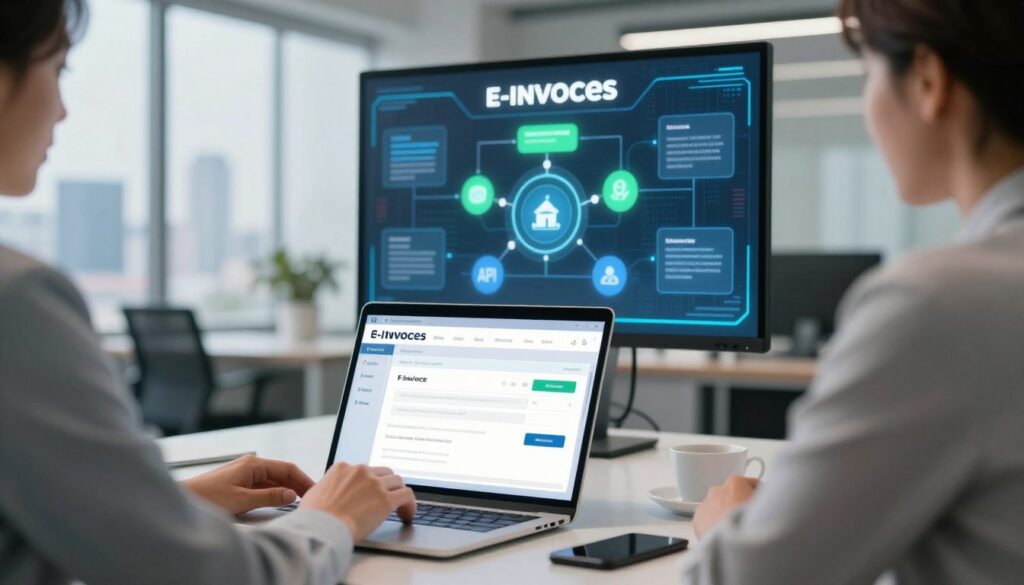
MyInvois Portal: low volume, manual workflows
Portal fits MSMEs and low transaction counts. It is free and simple to use for individual entries or occasional uploads.
Use portal when staff prefer manual entry or when a full software roll-out is not ready.
API Integration: high volume and ERP ties
API suits firms with frequent transmissions. Link your ERP or accounting system to automate submission, track validation, and store UINs.
Integration reduces manual steps and speeds reconciliation when many invoices flow daily.
Batch Upload: a pragmatic middle ground
Batch upload works for teams not yet on full API but issuing many records. It trims manual entry while avoiding heavy system change.
Control duplicates by assigning a single transmission owner and logging each file ID.
Security and compliance expectations
Protect invoice data in transit and at rest. Align controls with ISO/IEC standards, use role-based access, and keep audit logs.
Choose solutions that match transaction volume, staff capability, and data quality maturity rather than price alone.
Conclusion
,
Final note: near‑real‑time validation supports clean records and smoother audits, but it does not compute or lodge liability for your organisation.
Confirm turnover phase using FY2022 or YA2022 figures. Choose portal or API. Clean master data for buyers and suppliers. Train staff on cancellations and adjustments.
MyInvois validation strengthens audit trails and helps reconcile revenue with ledgers. Still, returns must be prepared and submitted separately.
Remember rollout began 1 Aug 2024 and continues through early 2026 with six‑month relaxation windows per phase. Avoid penalties and delays by acting early; early adoption also cuts disputes and boosts accuracy.
Use this page as an internal briefing for finance, operations, and IT so teams share one clear workflow and common definitions.
FAQ
Why do businesses confuse e-invoicing with income tax returns?
Many assume validated invoices automatically satisfy filing obligations because both involve tax data. In reality, validation through MyInvois provides an authoritative transaction record, but companies still must prepare and submit separate income tax returns to LHDN with aggregated figures and supporting schedules.
What is an electronic invoice under LHDN rules?
A validated digital transaction record submitted to MyInvois or a certified system. It contains required fields such as seller and buyer identification, line items, amounts, and a unique identification number that proves the invoice passed LHDN validation.
Does submitting validated invoices replace filing tax returns with LHDN?
No. Validated invoices improve recordkeeping and audit trails, but taxpayers must still compile financials, calculate taxable income, and file returns per Income Tax Act deadlines.
Who enforces e-invoicing and tax compliance in Malaysia?
Lembaga Hasil Dalam Negeri (LHDN) oversees tax compliance and runs the MyInvois validation platform. MyInvois handles validation, unique IDs, and QR code issuance for e-invoices.
When did mandatory e-invoicing phases begin and who is affected first?
Phased rollout began August 2024 for businesses with turnover above RM100 million. Subsequent phases include RM25–100 million (January 2025), RM5–25 million (July 2025), and RM1–5 million (January 2026), based on FY2022/YA2022 revenue.
How does LHDN determine which phase my business falls into?
LHDN uses your fiscal year 2022 revenue or Year of Assessment 2022 figures to assign a phase. The agency notifies mandation status and provides transitional guidance during the interim relaxation period.
Which business entities must comply with mandatory e-invoicing?
Companies, partnerships, limited liability partnerships, cooperatives, trusts, branches, and other registered entities are covered. Sole proprietors calculate combined turnover across businesses to determine mandation.
Are small businesses under RM1,000,000 turnover exempt?
Entities below RM1,000,000 may remain exempt, but once mandated they cannot revert to exemption. Exempt businesses do not need to issue consolidated or self-billed validated e-invoices unless they opt in.
Which documents must be issued as validated e-invoices?
B2B, B2C, and B2G invoices, debit notes, credit notes, and refund notes generally require validation. Disbursements, reimbursements, and certain cross-border documents can also fall under the rules depending on transaction specifics.
How does MyInvois validation work from submission to QR code?
Suppliers submit via the MyInvois portal, API, or certified software. The system validates required fields in near real-time, issues a unique identification number for valid records, and can generate a QR code so buyers can verify the invoice online.
What common data fields cause validation failures?
Missing or incorrect taxpayer identification numbers (TINs), mismatched buyer details, incomplete line-item descriptions, or wrong invoice types frequently trigger rejections. Annexure fields for exports and imports also require careful handling.
Can I edit a validated e-invoice in MyInvois?
No. Once validated, the invoice is immutable. Corrections require issuing debit notes, credit notes, or refund notes as validated e-invoices. You can use a single adjustment note to amend multiple originals when appropriate.
What is the 72-hour cancellation rule?
MyInvois typically allows cancellation within 72 hours of validation. After that window closes you must use formal adjustment documents (credit/debit/refund notes) to correct records, following LHDN rules.
How are cross-border transactions handled under MyInvois?
Malaysian buyers may need to self-bill foreign suppliers in certain cases. Bonded warehouse, free zone, drop-ship, and export/import scenarios require specific annexure fields and customs references to meet validation rules.
Will validated invoicing simplify tax audits?
Yes. Validated e-invoices create a reliable audit trail and reduce disputes over revenue and expense proof. However, auditors still require consolidated returns, supporting schedules, and other records beyond validated invoices.
What penalties apply for failing to issue validated e-invoices?
Non-compliance can trigger fines and operational risks like rejected invoices, delayed payments, and potential criminal penalties under the Income Tax Act. Timely compliance avoids business disruption and downstream liabilities.
Which submission method should my company choose: portal, API, or software?
Use the MyInvois portal for low volume or manual workflows. API integration fits high transaction volumes and ERP/accounting systems. Certified software offers batch uploads and controls to avoid duplicate transmissions while meeting security expectations.