The Inland Revenue Board started a digital shift in August 2024 to modernize tax handling. This change affects many taxpayers and aims to streamline the way transactions are recorded and reported.
The mandate requires businesses with an annual turnover between RM1 million and RM5 million to complete e-invoicing implementation by 1 January 2026. Owners must check their annual turnover revenue and plan system updates soon.
Successful compliance means integrating your accounting system with the official portal. Real-time validation of e-invoices and secure data exchange via an application programming interface will be central to the process.
Whether you are a seller, buyer, or employee in finance, these guidelines include issuance details, timelines, and examples for different industries. Early preparation reduces risk and saves time.
Key Takeaways
- LHDN mandated e-invoicing to improve tax compliance and transaction tracking.
- Businesses with RM1M–RM5M annual turnover must comply by Jan 1, 2026.
- Integration with the portal and API setup is required for real-time validation.
- Review annual turnover revenue and update systems early to avoid issues.
- This guide will cover issuance rules, documentation, and practical examples.
Understanding the E-Invoicing Mandate in Malaysia
The government’s shift to structured electronic billing changes how transactions are recorded and checked. This section defines the format, objectives, and practical effects of the mandate so businesses can plan implementation and integration.
What is an e-invoice
The Inland Revenue Board of Malaysia defines an e-invoice as a structured electronic document in XML or JSON format. That structure lets systems read and validate each record automatically.
Regulatory objectives
The primary goal is to boost tax transparency and shrink the shadow economy. Real-time validation via the portal ensures transactions are logged as they occur.
“Real-time validation improves data accuracy and reduces tax leakage,”
- Structured files (XML/JSON) enable seamless digital processing.
- The policy covers B2B and B2C transactions and supports issuance tracking.
- Training employees and updating systems helps ensure compliance by the target date.
| Area | Benefit | Action |
|---|---|---|
| Data accuracy | Fewer errors | Use structured formats |
| Transparency | Better tax reporting | Integrate with portal |
| Operational speed | Faster validation | Automate processes |
Who Needs E Invoice Malaysia in 2026
If your business reported annual revenue above RM1 million last year, prepare for mandatory electronic billing from 1 January 2026. This threshold determines whether you must move to structured e-invoicing and complete implementation on time.
Who falls inside the scope: companies with annual turnover between RM1 million and RM5 million. These businesses must issue validated e-invoices for every transaction to meet new tax rules.
Entities with annual turnover below RM1 million remain exempt for now. Still, review your accounts: audited statements or bookkeeping can show if your annual turnover revenue crosses the threshold.
- Calculate last year’s revenue to confirm your status.
- Plan system upgrades early to avoid compliance gaps.
- Use government services and guidance to support taxpayers, buyers, and sellers during rollout.
Act now: misclassification risks penalties and reporting errors. Verify your figures and schedule e-invoicing integration before the deadline.
Implementation Timeline and Phased Rollout
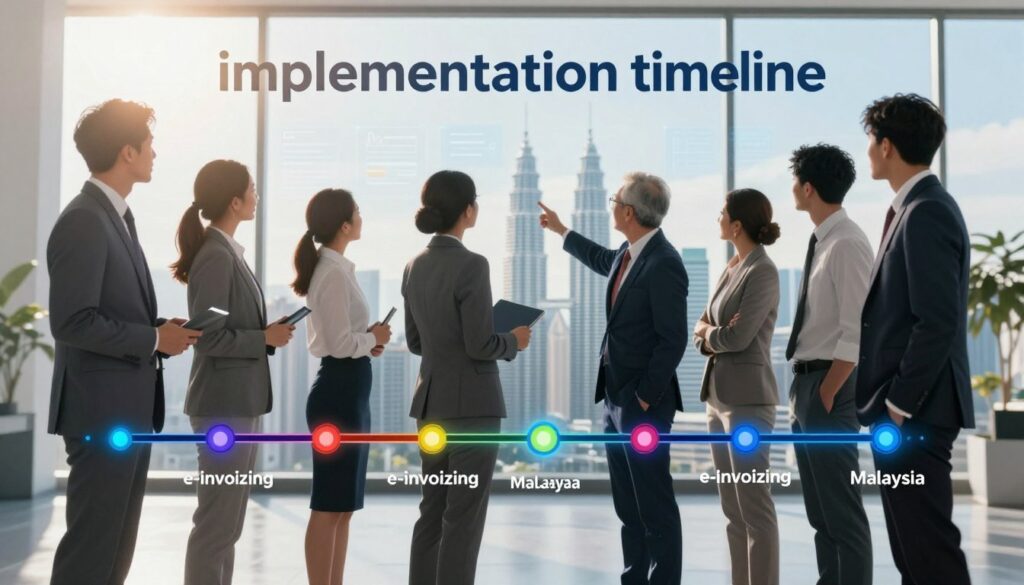
Phase 4 of the rollout starts at the beginning of 2026 and sets clear deadlines for affected firms.
Start date: 1 January 2026 — this phase targets businesses with annual turnover between RM1 million and RM5 million. The government gives a structured window to complete system integration and testing.
Relaxation periods and grace periods
The Inland Revenue authority provides a six-month relaxation period. During this time, taxpayers who make a good-faith effort will not face prosecution for minor non-compliance.
This grace period allows teams to test the process to issue e-invoices, validate data fields, and fix integration issues with the official system. Use available services and guidance to resolve technical challenges.
- Final phase date: 1 January 2026
- Six-month grace for minor non-compliance
- Test system integration and data completeness
| Milestone | What to do | Expected outcome |
|---|---|---|
| Pre-launch (now) | Assess annual turnover and ready systems | Clear plan and timeline |
| Launch date | Begin issuing validated e-invoices via portal/API | Transactions logged in real time |
| Six-month period | Fix issues, refine processes, use support services | Full compliance readiness |
“Use the relaxation period to iron out integration and process gaps before full enforcement.”
Determining Your Business Compliance Status
Before you plan system changes, confirm your annual records. Check the audited financial statements or tax returns for the relevant Year of Assessment.
Calculating annual turnover
Use audited totals and official guidance to calculate annual turnover accurately. The government sets clear rules on which items to include.
Key point: once a business crosses the RM1 million threshold, it must continue to issue e-invoices for future transactions even if revenue falls later.
Audited financial statements
Audited statements and tax filings are primary evidence. Keep records current so you can prove your status during the compliance period.
- Review audited totals and reconcile with bookkeeping.
- Ask a tax professional if figures are unclear.
- Prepare systems before the required date to avoid gaps in the timeline.
| Document | Use | Action |
|---|---|---|
| Audited financial statements | Primary proof of annual turnover | Verify totals and retain copies |
| Tax returns | Supporting evidence for Year of Assessment | Cross-check figures with accounts |
| Management reports | Operational view of transactions | Use for planning implementation |
Technical Requirements for Issuing E-Invoices
Technical standards define how every e-invoice must be built and sent. Each record must include 55 mandatory data fields. These fields capture seller and buyer details, prices, taxes, and transaction identifiers.
Transmission goes via the MyInvois portal for manual entry or an API for automated, high-volume processing. Choose the portal if staff will key data. Pick API integration for batch processing and real-time flows.
- Confirm all 55 data fields map to your accounting system.
- Validate data formats to avoid rejection during tax validation.
- Ensure network links meet cybersecurity and compliance standards.
“Accurate data and secure integration cut validation errors and speed processing.”
| Requirement | Why it matters | Action |
|---|---|---|
| 55 mandatory fields | Complete records for tax checks | Map fields and test exports |
| Portal / API | Manual vs automated submission | Choose method and run end-to-end tests |
| System security | Protect transaction data | Apply encryption and access controls |
Authorities publish detailed documentation and test sandboxes. Use these resources during implementation to minimise downtime and keep your business compliant during the transition period.
Navigating the E-Invoicing Process
A practical first step is deciding whether staff will key entries into the portal or automate via API. That choice shapes your workflow, training needs, and testing plan.
MyInvois Portal usage
The portal suits low-volume teams or occasional entries. Staff can issue e-invoice records manually and view validation responses in real time.
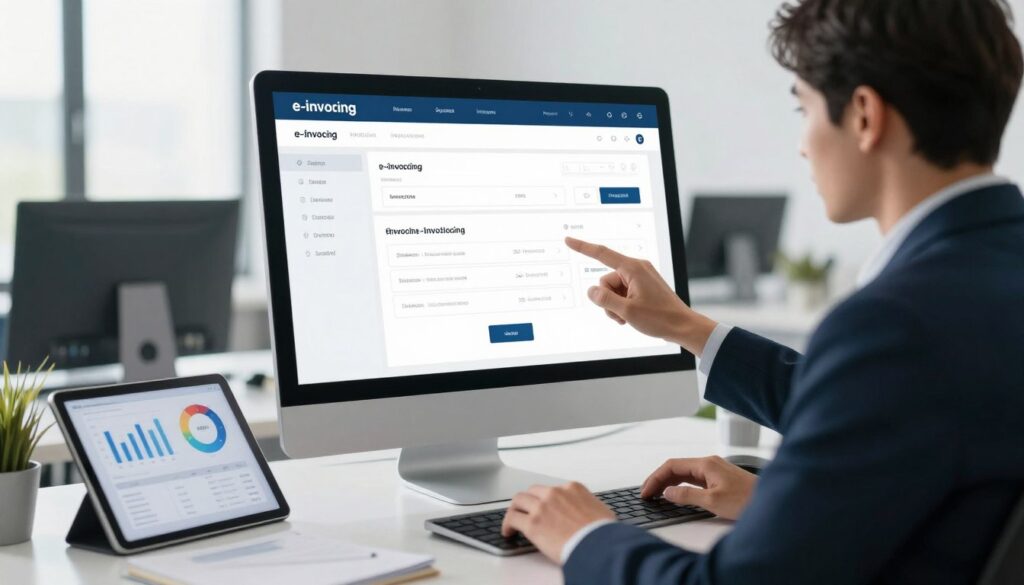
Use the portal to check required fields and correct small errors before they become systemic.
API integration methods
For high-volume businesses, integrate your billing system with the official API. Automation reduces manual steps and speeds validation.
Test mapping of buyer IDs and transaction data, then run staged batches to avoid disruptions.
Handling B2C transactions
Suppliers must issue e-invoices for B2C sales, but sellers may consolidate if the buyer does not request individual documents.
Every transaction is validated immediately and a 72-hour window exists for cancellations or rejections. Track corrections and record reasons for audit trails.
“Accurate buyer identification and neat integration keep validation errors low.”
Understanding Exemptions and Special Cases
Not all entities or payment types fall under the new e-invoicing rules. The government exempts foreign diplomatic offices, individuals not conducting business, and taxpayers with annual turnover below RM1 million.
Certain income types are outside the mandate. Employment income, pensions, and scholarships do not require a consolidated e-invoice or separate e-invoices from payers.
The authorities also list specific scenarios that permit self-billed documents. Examples include payments to foreign suppliers and expenses claimed by an employee on behalf of an employer.
- Check the guidelines to confirm when to issue e-invoice records and when a consolidated e-invoice is acceptable.
- Industries and services with special rules are clearly defined to reduce unnecessary work for affected businesses.
- Review each case so your system and portal integration only covers transactions that legally require reporting.
“Exemptions aim to lower burden while keeping the tax system accurate.”
Careful review of the official guidance helps teams avoid extra compliance steps. Use the examples supplied by the authorities to decide treatment of complex transactions and to plan implementation timelines.
Overcoming Common Implementation Challenges
Many teams find the biggest hurdle is adapting daily routines to new digital billing rules. Small firms and larger organisations both face resistance when a familiar system changes.
Change management strategies
Start with short, role-based training so every staff member can perform core tasks. Clear steps reduce errors and speed adoption of the new platform.
Test integrations early. Map fields, verify data exchange with the portal, and run staged batches to confirm that you can issue e-invoice records and receive validation responses.
Address legal risks head on. Non-compliance carries fines from RM200 up to RM20,000 and possible imprisonment, so treat testing and staff readiness as high priority.
- Train users in small cohorts and document workflows.
- Monitor data transfers and fix mapping errors fast.
- Use government resources and case examples to guide implementation.
“Companies that invest in training and robust software report smoother transitions.”
Conclusion
As the 2026 deadline approaches, firms must finalise plans to move billing onto the structured digital platform. Prioritise e-invoicing readiness, check annual turnover figures, and map system fields to the portal. Use available services and the inland revenue board guidance to reduce risk.
Good implementation shortens validation time and helps maintain tax transparency. Train staff, run test batches, and confirm every buyer and seller role so each transaction records correctly. Early action lowers the chance of penalties and operational delays.
Stay focused on compliance and practical steps. With clear planning and the right support, businesses can complete the transition smoothly and benefit from a more efficient, transparent accounting environment.
FAQ
Who must implement electronic invoicing in Malaysia in 2026?
Businesses and taxpayers with annual turnover above the threshold set by the Inland Revenue Board must adopt electronic invoicing. This includes corporations, partnerships, sole proprietors and service providers operating in taxable sectors. The consolidated requirement targets sellers who issue invoices for taxable supplies, especially those in industries with frequent transactions.
What is an electronic invoice under the new mandate?
An electronic invoice is a digitally issued document that contains transaction details, seller and buyer identification, tax breakdowns and timestamps, delivered through approved systems or the MyInvois portal. It must conform to data, format and authentication rules so authorities can verify tax liabilities and audit trails efficiently.
What are the regulatory objectives behind the e-invoicing rollout?
The Inland Revenue Board aims to improve tax compliance, reduce invoice fraud and simplify reporting. The initiative seeks faster reconciliations, better transaction visibility for authorities and lower administrative costs for businesses through automation and standardized data exchange.
Who is covered by the 2026 requirement?
The mandate applies to entities whose annual turnover exceeds the specified revenue threshold, plus selected industries identified for early adoption. Authorities may publish phases listing sectors and taxpayers required to comply during each period, so affected parties should check official guidance and timelines.
How will the phased rollout and timeline work?
The Inland Revenue Board will implement the mandate in stages. Each phase specifies effective dates for different taxpayer groups. Phased rollout allows time for system upgrades, testing and training. Firms should monitor announcements for precise cut-off dates and transition windows.
Are there relaxation or grace periods for compliance?
Yes. Authorities typically offer grace periods during initial phases to help businesses adapt. These windows often permit limited temporary exceptions or reporting adjustments while systems and integrations are validated. Firms should document efforts and seek guidance if they need extensions.
How do I calculate annual turnover to determine obligation?
Calculate total gross revenue from all taxable and non-taxable supplies over the defined assessment period, following Inland Revenue Board rules. Include domestic sales, rendered services and other receipts specified in the revenue definition. Use audited figures or management accounts per the authority’s instructions.
Do audited financial statements matter for eligibility?
Yes. Audited statements provide the definitive revenue basis where required. For some taxpayers, authorities will accept management accounts for initial assessment, but audited statements may be required for verification, appeals or later compliance checks.
What technical requirements must my system meet to issue compliant invoices?
Systems must support mandated data fields, secure digital signatures or authentication, timestamping, and format standards set by the authority. They should enable export to approved schemas and allow communication via the MyInvois portal or approved APIs. Security, access controls and reliable logging are essential.
How do I use the MyInvois portal for issuance and reporting?
MyInvois lets taxpayers create, submit and store compliant invoices. You can upload single or bulk records, validate fields against templates and retrieve issuance statuses. The portal also provides reporting tools and downloadable archives for audit and reconciliation.
What API integration methods are available?
Integration can be direct via RESTful APIs, middleware connectors or through certified service providers. Options include synchronous submission for real-time validation or batch upload for bulk transactions. Vendors may offer plug-ins for accounting software to streamline the flow of invoice data.
How should businesses handle consumer (B2C) transactions?
For B2C sales, invoices still need required metadata and tax details, but simplified reporting options may apply if buyer identification is limited. Retailers can use point-of-sale integrations or batch uploads to the portal; ensure receipts and summaries align with the mandated data fields to maintain compliance.
Which transactions or taxpayers might be exempt or subject to special treatment?
Exemptions may cover small businesses below the turnover threshold, certain government transactions, or sectors granted special status. Seasonal traders, non-resident suppliers and specific service categories may receive tailored rules. Check Inland Revenue Board guidelines for official exemption lists and application procedures.
What are common implementation challenges and how can we overcome them?
Typical hurdles include system integration, staff training and data quality issues. Overcome them by conducting a gap assessment, allocating budget for IT upgrades, engaging certified software vendors, and running pilot tests. Establish clear internal workflows and assign compliance owners to manage the transition.
What change management strategies help with adoption?
Communicate early with stakeholders, provide hands-on training, create user guides and schedule phased rollouts. Appoint champions within finance and IT teams, track KPIs like error rates and processing time, and gather feedback for continuous improvement. Using external consultants can accelerate compliance and reduce disruption.