As Malaysia moves toward a net-zero future, small and medium enterprises must act now to stay competitive. Larger partners and global buyers are asking for clear sustainability data, and many smes face the risk of exclusion from key supply chains if they delay.
This short guide outlines a simple path to begin the journey. The Simplified ESG Disclosure Guide (SEDG) offers a practical starting point to measure progress and meet stakeholder expectations.
By starting early, your business can reduce risk, build resilience, and keep access to markets that value environmental and social responsibility. The steps are manageable and designed for smes with limited resources.
Key Takeaways
- Start collecting basic sustainability data now to protect supply chain access.
- The SEDG is a practical first step for small firms.
- Early action reduces risk from future rules and buyer demands.
- Simple measures can improve long-term resilience and reputation.
- Preparing now keeps your business competitive in global markets.
Understanding the Current ESG Landscape for Malaysian SMEs
Local businesses are seeing fast change as sustainability moves into core strategy for buyers and regulators. With roughly 1 million enterprises nationwide, nearly 97% fall into the small and medium category. That scale means collective shifts matter.
Government signals and big corporations now favour firms that adopt clear environmental and social practices. This trend makes esg adoption a strategic choice rather than only a values-led one.
Leadership teams can start by mapping current operations to simple standards. That helps identify gaps and quickly improve efficiency, costs, and market access.
“Standardized practices help smaller firms align with national goals and stay competitive in global supply chains.”
| Area | Why it matters | Quick action |
|---|---|---|
| Energy & Emissions | Lower costs, risk reduction | Track usage monthly |
| Labor & Safety | Worker retention, compliance | Adopt basic policies |
| Procurement | Supply chain access | Request supplier data |
| Governance | Stakeholder trust | Set clear roles |
Why ESG Reporting Malaysia SME Adoption is a Strategic Necessity
Adopting clear sustainability practices now lets small firms keep access to important buyers. This is more than compliance. It is a business move that protects market access and supports future growth.
Competitive Advantage in Global Supply Chains
Companies that demonstrate transparent environmental and social performance win priority in global supply chains. Large buyers favour suppliers who can show data and consistent practices.
Standard Chartered ranks the country 7th globally for supply chain exclusion risk when suppliers cannot provide sustainability data.
Meeting Stakeholder Expectations
Stakeholders—from buyers to financiers—expect clear information on impact and controls. Meeting those expectations opens opportunities and builds trust with international partners.
| What to show | Why it matters | Quick next step |
|---|---|---|
| Energy use & emissions | Cost savings, buyer confidence | Start monthly tracking |
| Worker safety & policies | Retention and compliance | Publish basic policies |
| Supply transparency | Access to global contracts | Request supplier data |
Navigating the Simplified ESG Disclosure Guide
The Simplified ESG Disclosure Guide breaks down complex expectations into clear, usable steps for smaller firms.
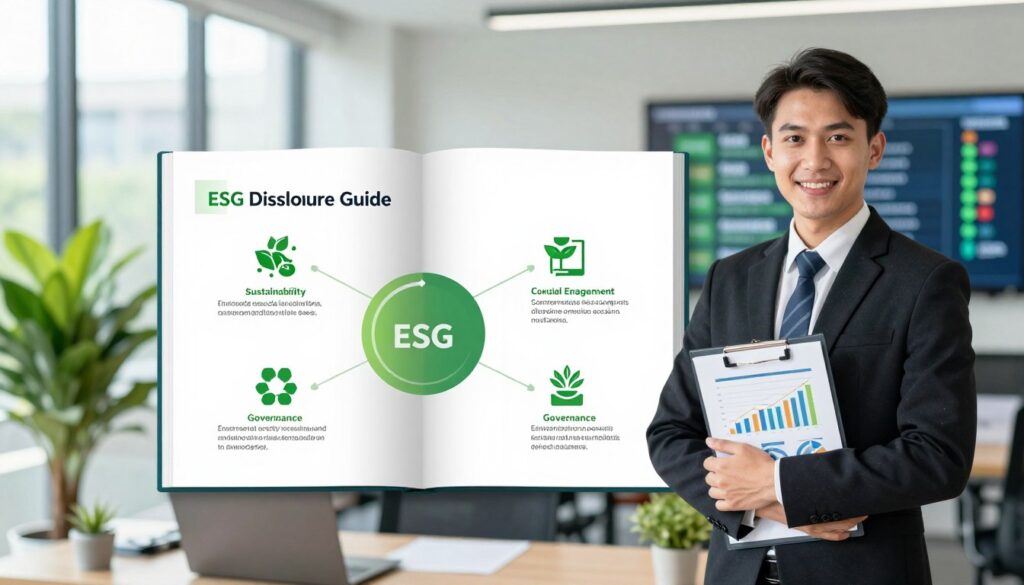
The SEDG, launched by Capital Markets late in 2023, offers 35 sector-agnostic disclosures. It helps companies collect consistent data and answer varied requests from larger partners.
Understanding the Modular Maturity Levels
The guide uses a modular design with three maturity tiers: Basic, Intermediate, and Advanced. Each level maps to practical actions and clear documentation that stakeholders can review.
- Basic: Start with key disclosures and simple controls.
- Intermediate: Add process metrics and governance steps.
- Advanced: Provide full disclosures and performance trends.
About 250,000 smes in national supply chains are the main audience. The guide and its development fund support aim to help smes adopt a standard framework without heavy cost.
| Tier | Focus | Quick win |
|---|---|---|
| Basic | Essential disclosures | Monthly data logs |
| Intermediate | Process & governance | Policy templates |
| Advanced | Performance & assurance | Trend charts |
Using this disclosure guide lets companies meet supply requirements and build governance for future capital markets access. The SEDG gives clear guidance for steady development.
Leveraging Sector Specific Guides for High Impact Industries
Tailored guidance can turn broad sustainability goals into concrete steps for high-impact sectors. This guide approach helps companies focus on the most material impact areas for their operations.
Capital Markets introduced sector-specific guides for high-emissions areas like energy and manufacturing. The guides also cover Transport and Logistics, Construction and Real Estate, and Agriculture.
The esg disclosure guide and related disclosure guide modules explain which disclosures matter most. They show how to handle biodiversity, climate-related risks, and other sector-specific concerns.
Government-supported guidance gives smes practical tools for adoption. By using these materials, companies can align practices with industry standards and show clear commitment to sustainability.
- Targeted disclosures unlock better access to buyers and financiers.
- Sector guides simplify what to track and how to act.
- Adoption supports steady growth and stronger market relevance.
Addressing Human Rights and Labour Standards in Your Operations
Simple, consistent labour practices help businesses meet international standards and avoid costly disruptions.
The disclosure guide highlights human-rights and labour standards as a key social pillar. It focuses on risks in labour-heavy sectors such as Agriculture and Manufacturing.
The Human Rights and Labour Practices guide helps smes identify forced-labour risks and set controls. It gives clear steps to train staff, vet suppliers, and document recruitment and payroll practices.
Embedding these practices into daily operations protects migrant workers and improves compliance in Construction and Real Estate. Regular checks and worker feedback loops reduce harm and build trust.
“Proactive social disclosures help firms avoid reputational damage and secure buyer confidence.”
Practical guidance—from templates to simple audits—lets small firms scale controls without big cost. Consistent disclosures on labour conditions signal commitment and lower long-term impact on business and energy use across supply chains.
- Train managers on worker rights.
- Use recruitment checks and clear contracts.
- Record and publish core social disclosures regularly.
Utilizing Standardized Templates and Tools for Reporting
Standardized tools make it easier for small firms to turn raw bills and logs into usable data. That lowers the time needed to prepare disclosures and strengthens governance for buyers and financiers.

Automating GHG Emissions Calculations
Automated calculators accept energy bills and convert consumption into emissions estimates. This reduces manual errors and speeds up regular tracking of esg progress.
Workshops in the SEDG Adopters programme train staff to use these tools and interpret outputs for stakeholders.
Using Standardized Excel Templates
Capital Markets provides Excel templates that streamline how smes collect monthly inputs and produce neat summaries for partners.
These standardized frameworks cut administrative burden. Firms can focus on improving environmental performance and governance rather than wrestling with formats.
| Tool | Benefit | Quick step |
|---|---|---|
| GHG calculator | Fast emissions data | Upload energy bills |
| Excel template | Consistent records | Use monthly logs |
| Adopter workshops | Staff training | Join sessions |
Joining the Adopters Programme for Practical Support
Joining a structured adopter network speeds practical change and cuts trial-and-error for small firms.
The SEDG Adopters Programme brings together 46 participants, from multinationals to banks and trade chambers. It is a knowledge-sharing hub that helps smes adopt the simplified esg disclosure and practical frameworks.
Members get in-person training and workshops run by Capital Markets to turn plans into action. These sessions focus on simple tools, monthly data logs, and governance steps that companies can use right away.
The programme builds acceptance among data requesters and shows that a chosen disclosure guide is credible. Continuous feedback loops let firms adapt disclosures as buyer needs evolve.
For malaysian smes, joining offers direct access to peers, templates, and practical advice. This support helps firms become ESG-ready and protect their place in global supply chains.
- Practical training to implement the simplified esg disclosure.
- Peer feedback and credibility with requesters.
- Tools and templates to speed adoption and reduce cost.
Overcoming Common Challenges in Sustainability Measurement
Turning bills and logs into trusted numbers is the key that unlocks buyer confidence for small businesses.
The SEDG offers a clear, phased path so smes can tackle complexity one step at a time.
Strategies for Effective Data Collection
Start with standardized templates to capture monthly energy use and basic workforce metrics. Templates reduce errors and free time for improvement.
Use simple tools—spreadsheets or the provided calculators—to convert consumption into emissions estimates. This builds reliable data that stakeholders accept.
Work with partners. Government agencies and industry bodies run workshops and the Adopters Programme to fill knowledge gaps and resolve missing data points.
| Challenge | Practical fix | Quick outcome |
|---|---|---|
| Scattered records | Standard template | Consistent monthly logs |
| Missing supplier info | Request minimal disclosures | Supply chain visibility |
| Staff time limits | Adopter training | Faster data collection |
By focusing on modular steps, companies can meet supply requirements and show steady esg progress that supports growth and stronger governance.
Conclusion
,Begin now to protect your place in global supply chains and sharpen your firm’s resilience.
Small firms can use the SEDG to take clear, staged steps toward better sustainability and stronger links to buyers.
Use standard tools and join adopter groups to speed the adoption curve. This lowers cost and builds practical skills for consistent reporting.
Acting early keeps smes competitive and helps secure future supply opportunities. Make steady improvements now to protect your chain and future growth.
FAQ
What is the main benefit for small and medium enterprises to start preparing sustainability disclosures now?
Preparing disclosures early builds trust with buyers, financiers, and regulators. It helps businesses join global supply chains, access capital, and reduce operational risks by tracking energy use, waste, and social practices. Early adoption also makes compliance easier as standards evolve.
How do I understand the current landscape for sustainability measures among Malaysian small businesses?
Look at government guidance, industry associations, and buyer expectations. Many firms are moving toward basic metrics—energy, waste, and worker safety—so compare your operations to peers and identify gaps you can close quickly with low-cost actions and simple data collection.
How can adoption give my business a competitive advantage in global supply chains?
Buyers increasingly require evidence of environmental and labour practices. Demonstrating clear policies, basic measurements, and improvement plans makes suppliers more attractive and reduces the risk of contract loss. It also opens doors to export markets and multinational partners.
What stakeholders should I prioritize when starting disclosure work?
Start with customers, lead buyers, and lenders, then include employees and regulators. Focus on the concerns that matter most to them—product safety, timely delivery, worker conditions, and basic environmental performance—to ensure your efforts deliver measurable value.
How does the simplified disclosure guide help smaller firms?
The guide breaks down practice into manageable modules and maturity levels. It tells you which actions to take first, how to measure progress, and what documentation to keep. This reduces complexity and helps businesses improve step by step.
What are modular maturity levels and how do they work?
Modular maturity levels define stages from basic awareness to systematic management. You start with simple measures—policies and basic data—then progress to targets, monitoring, and continual improvement. Each level has clear, achievable criteria.
Are there sector-specific resources for high-impact industries like manufacturing or food processing?
Yes. Many sector guides focus on the most relevant issues for each industry, such as water use for food processing or chemical management for manufacturing. These guides recommend tailored metrics and practical steps that deliver the biggest impact.
How should I handle labour and human rights concerns in my day-to-day operations?
Implement clear labour policies, fair contracts, and health-and-safety checks. Train supervisors, set grievance channels, and document working hours and wages. These steps protect workers and reduce legal and reputational risk.
What tools can make reporting simpler and less time-consuming?
Use standardized templates, simple spreadsheets, and basic data-collection apps. Templates guide what to collect, while calculators automate emissions and energy conversions. Choosing tools that match your scale avoids unnecessary complexity.
How can I automate greenhouse gas calculations without hiring specialists?
Start with online calculators and spreadsheet templates that convert energy use into emissions using standard factors. Track fuel and electricity use, keep consistent units, and document assumptions. Outsource complex reviews only when you scale up.
Are there ready-made Excel templates I can adopt right away?
Yes. Many templates cover energy use, waste, and basic social indicators. They standardize columns and formulas so staff can enter monthly data and generate summary reports for buyers and lenders.
What is an adopters programme and how does joining help?
An adopters programme provides practical support, mentoring, and peer learning. Members get tailored coaching, access to tools, and feedback on disclosure drafts. This practical help speeds implementation and builds confidence.
What common challenges do firms face when measuring sustainability performance?
Typical issues include incomplete data, inconsistent units, limited staff time, and unclear responsibilities. Small firms also struggle with integrating new tasks into daily operations and proving value to management.
What strategies work best for effective data collection?
Assign clear owners for each metric, standardize measurement units, collect data monthly, and use simple forms or spreadsheets. Train staff on why data matters and keep records organized so audits and buyer queries are easy to handle.
How do I keep disclosure efforts proportionate to my business size and capacity?
Focus on high-impact, low-cost actions first—energy savings, waste reduction, and worker safety. Use modular approaches to expand gradually, and select templates and tools that match your staff capacity to avoid overburdening operations.
Will making disclosures increase my costs significantly?
Initial costs are usually modest—time for data collection and simple tools. Many measures also reduce costs through energy savings and efficiency gains. Think of disclosure as an investment that can unlock new contracts and finance.