Are you a Malaysian creator, KOL, or social seller wondering Do Influencers Need to Issue e-Invoice? This short guide explains the basics and what changes when you get paid by brands, platforms, agencies, or followers.
Malaysia now uses real-time validation through MyInvois, run by IRBM/LHDN. The system verifies structured, validated records rather than accepting a plain PDF.
This page acts as a friendly FAQ. It will show when you fall in scope, which transactions count (brand deals, merch, subscriptions, and cross-border sales), and what data fields the portal or API requires.
Who this is for: full-time creators, part-time gig creators, social sellers, and sole proprietors with multiple income streams under one taxpayer identity.
Rules roll out by annual turnover bands from August 2024. Some exemptions may apply, but once you are in scope, ongoing compliance matters even if income swings.
Key Takeaways
- You may need to issue e-invoices if your turnover meets the phased thresholds.
- MyInvois validates structured invoices in real time via IRBM/LHDN.
- Covered transactions include brand work, merchandise, subscriptions, and cross-border sales.
- Compliance timing depends on annual revenue bands starting Aug 2024.
- Sole proprietors and creators with mixed income should track thresholds and records.
Influencer e-Invoice Malaysia Basics for KOLs and Creators
If you bill brands or sell merch, the format of your invoice matters. When you send a structured invoice in Malaysia, MyInvois runs automatic checks and returns a quick validation result.
What an e-invoice is and why it’s not a PDF
An e-invoice is a structured digital document—usually XML or JSON—that the MyInvois platform accepts for automated processing.
Unlike a PDF, JPG, or screenshot, a structured file contains labeled fields. That makes data readable by software. A PDF may look like an invoice to a human, but it lacks the machine-readable structure needed for reporting.
Who validates and what “real-time” means
The IRBM/LHDN-backed MyInvois system checks submitted files against required fields and rules. This validation happens quickly, often within moments.
“A validated e-invoice receives a Unique Identification Number (UIN) and a QR code for easy verification.”
- Accepted invoices get a UIN and QR code for buyers and audits.
- Rejected files show errors you must fix before resubmitting.
- This system supports Malaysia’s digital tax shift by cutting manual mistakes.
For content creators billing for services, licensing, or merchandise, matching the e-invoicing format keeps payments verifiable and compliant with local tax rules.
Do Influencers Need to Issue e-Invoice?
If you earn repeat income from brand work, your creator activities can meet Malaysia’s legal test for carrying on a business.
Repeated, income-driven acts — like sponsored posts, affiliate campaigns, livestream selling, or paid appearances — often look like commercial activity. If you sell regularly or offer paid services, authorities may treat you as a business. That classification affects whether you must comply with e-invoicing rules.
Which billable work typically triggers e-invoicing
- Services: content packages, campaign management, UGC deliverables, event hosting, emceeing, livestream sessions, consulting, and licensing content.
- Goods: merch, physical products, and creator kits shipped to customers.
- Collaborations: cash, product value, or mixed consideration count as a commercial transaction and should be documented when you issue e-invoices.
Key point: your job title doesn’t matter—what matters is whether you receive income from business-like transactions. Track sales and turnover against rollout thresholds so you know when you require e-invoices and how that affects your tax reporting.
Who must comply with e-invoicing in Malaysia
Malaysia’s e-invoicing framework applies across many business types, not just traditional firms with offices and staff. That means creators, freelancers, and online sellers should check if they fall into scope based on activity and receipts.
Self-employed, freelancers, gig workers, and online sellers
- This group includes those earning from social commerce, paid digital services, and platform sales.
- If your sales are regular and billed, you may be classed as carrying on a business and therefore must comply.
Sole proprietors and combined revenue
- Sole proprietors must add revenue from all ventures under their tax identity.
- Combined annual revenue, not each shop or service separately, determines your compliance phase.
Dormant versus active commercial activity
- Dormant companies or entities with no transactions generally do not issue invoices for that period.
- Once you start billing or selling again, the obligation can begin immediately if thresholds are met.
Even as an individual, repeated paid services or steady sales can make you a business in the eyes of regulators. Review brand retainers, affiliate fees, and digital product receipts so your invoicing matches what buyers and authorities expect.
Malaysia e-Invoicing Mandate Timeline and Rollout Phases (Based on Annual Revenue)
Phased implementation means the date you must comply depends mainly on how much revenue your creator operations report.
Rollout is based annual turnover. The government set clear start dates so businesses can plan their systems and invoices.
- Phase 1 — 1 Aug 2024: >RM100,000,000
- Phase 2 — 1 Jan 2025: RM25,000,000–100,000,000
- Phase 3 — 1 Jul 2025: RM5,000,000–25,000,000
- Phase 4 — 1 Jan 2026: RM1,000,000–5,000,000
How to confirm which phase applies
Check your audited financial statement or your tax return. Many taxpayers use Year of Assessment 2022 (YA2022) as the default reference.
What if you cross a threshold later?
If your annual revenue rises above a band, track it carefully. Compliance generally starts in the second year after you cross the level. That gives a short runway for implementation and systems testing.
“Plan early: track receipts, update workflows, and collect buyer details so the mandate fits into your billing routine.”
Annual Revenue Thresholds and Exemptions: Do You Qualify?
Small creators must watch their yearly takings: a sudden high-value deal can move you into a new compliance band.
Revenue-based exemption and what “below threshold” means in practice
Sources note an exemption for annual revenue below RM1,000,000. Another source lists RM500,000 with conditions.
That means you should track sales closely. A single large brand campaign can push your totals up and change your e-invoicing status.
Entity-based exemptions
Certain entities are excluded: foreign diplomatic and consular offices and individuals not carrying on businesses.
If you are an individual who rarely sells or provides occasional services, you may be outside scope. Confirm your status with IRBM/LHDN guidance.
Special timing exemptions
Some statutory bodies, local authorities, and international organizations have limited timing relief for transactions concluded before 1 July 2025.
This mainly affects public entities rather than creators, but it shows the framework’s scope.
“If you are in scope, each relevant transaction must produce compliant e-invoice data, regardless of invoice size.”
| Criterion | Common Guidance | Action for Creators |
|---|---|---|
| Below threshold | RM500,000–RM1,000,000 (varies) | Track revenue; review annually |
| Entity exemptions | Diplomatic/consular, non-business individuals | Self-screen; confirm with tax office |
| Timing relief | Statutory bodies before 1 Jul 2025 | Not typically applicable for creators |
Practical reminder: even if exempt now, keep clean buyer and seller records and copies of invoices so you can transition smoothly if annual revenue grows.
Transactions Influencers Must Issue e-Invoices For
Classifying a payment as B2B, B2C, B2G, or cross-border changes how you record it.
The e-invoicing mandate is transaction-driven, not platform-driven. That means each transaction type determines whether invoices must be validated through MyInvois. Online marketplaces, social platforms, or payment apps do not change the classification.
B2B: brand deals and agency retainers
B2B transactions include brand deals, agency retainers, production fees, licensing, and campaign bundles. Companies often require validated invoices for their accounting and tax records.
B2C: direct sales and subscriptions
Sales to consumers cover merch, paid communities, subscriptions, digital downloads, templates, and courses. High-volume, small-value sales can overwhelm manual workflows without proper systems.
B2G: government and public contracts
Work for government-linked customers or agencies usually has stricter procurement checks. These projects often require compliant invoices and detailed buyer data.
Cross-border: overseas clients and self-billed imports
Overseas services and imported goods may trigger self-billed scenarios where the Malaysian buyer generates the invoice. Roles can shift: the supplier may be treated differently under import rules.
“Getting transaction classification right reduces rework from rejected validations and speeds payment.”
| Transaction Bucket | Common Examples | Who typically requires validated invoices | Practical note |
|---|---|---|---|
| B2B | Brand campaigns, retainers, licensing fees | Companies and agencies for tax and audit | Include buyer company registration and contact details |
| B2C | Merch, subscriptions, digital courses | Consumers and marketplace buyers | Use systems for consolidated or high-volume sales |
| B2G | Public awareness content, tourism campaigns | Government departments and linked agencies | Follow procurement rules and provide extra documentation |
| Cross-border | Foreign clients, imported tools, self-billed imports | Overseas companies or Malaysian buyers who self-bill | Clarify supplier/buyer role and VAT/tax implications |
Quick tip: Classify each sale before you prepare invoices. That helps you include the correct buyer details and lowers the chance of a rejected validation by the MyInvois systems.
What Data Is Required on an e-Invoice (Malaysia requirements you can’t skip)
Structured e-invoices require specific file formats and exact fields before Malaysia’s portal will accept them.
Format standard: UBL 2.1 in XML or JSON
Malaysia mandates UBL 2.1 as the standard format. Your billing tool must export XML or JSON that matches the schema. A visually tidy PDF is not enough.
Core fields every creator should prepare
The system expects 55 detailed data points. Key fields include seller identity, buyer identity, item or service description, quantities, unit pricing, totals, tax entries, and payment details.
Missing buyer fields or incomplete totals commonly cause validation failures. Creators who collect only an email or social handle must request official buyer identifiers before billing.
Digital signature and authenticity
Each e-invoice must be digitally signed with an IRBM-issued Digital Certificate. This ensures integrity and supports audit trails for tax purposes.
“Prepare complete, standardized information before submitting to avoid rejected validations.”
| Field Group | Examples | Why it matters |
|---|---|---|
| Identity | Seller registration, supplier tax ID, customer name | Verifies parties for tax and audit |
| Line details | Description, quantity, unit price | Maps costs for totals and VAT rules |
| Totals & payments | Subtotals, taxes, grand total, payment terms | Prevents calculation rejections |
Practical tip: standardize naming, keep a buyer master list, and confirm your invoicing systems can populate all required fields before sending an e-invoice.
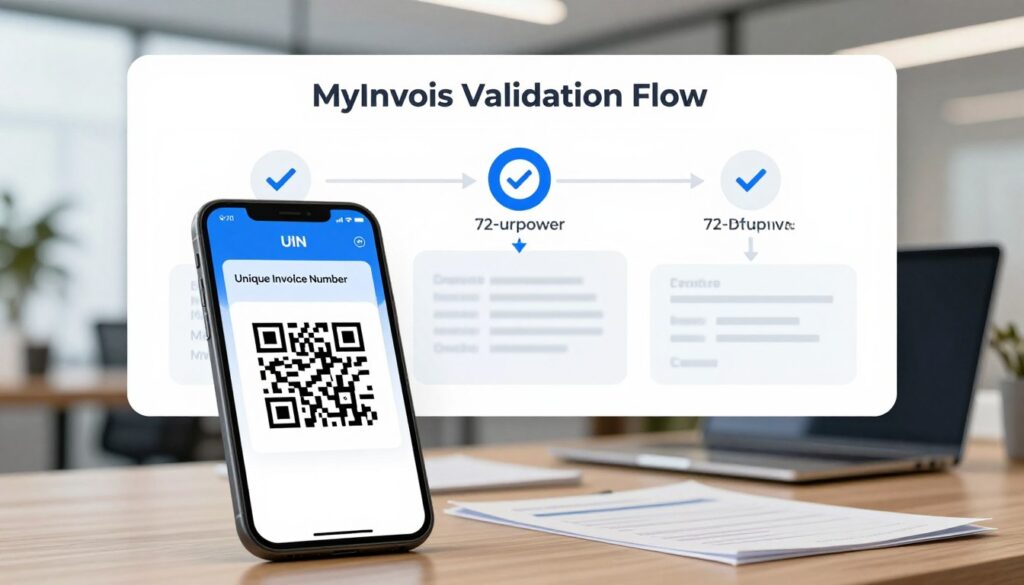
MyInvois Validation Flow: UIN, QR Code, and the 72-Hour Window
MyInvois vets each submission instantly and returns a validation result that sets the next steps for a creator and buyer.
How the validation lifecycle works
Submission → real-time validation → accepted or rejected outcome → share a human-readable copy with a QR code for the buyer.
Accepted files receive a Unique Identification Number (UIN) and a QR code that buyers can scan to verify details. This makes audits and payment reconciliation faster.
What triggers acceptance or rejection
Common acceptance drivers: complete required data, valid buyer and seller identifiers, correct totals, and the right structured format.
Common rejections: missing buyer fields, mismatched totals, wrong classification of items or services, or uploading in the incorrect structured format.
72-hour rejection and cancellation rules
There is a 72-hour window for rejection or cancellation after a validated entry. Any change needs clear justification.
“Justification matters: explain campaign scope changes or payment adjustments to preserve audit trails.”
| Stage | What happens | Creator action |
|---|---|---|
| Submission | File sent in UBL/XML or JSON | Ensure all required data fields are filled |
| Validation | Real-time accept or reject | Fix errors and resubmit if rejected |
| Post-acceptance | UIN and QR code issued | Share human-readable copy with buyer |
| 72-hour window | Reject/cancel with justification | Keep documentation for credit/debit notes |
How Influencers Can Issue e-Invoices: MyInvois Portal vs API Integration
Creators can send an e-invoice either by typing them into MyInvois or by wiring their billing software to the portal.
MyInvois Portal for lower-volume creators
The portal works well for occasional bills. You can enter a single invoice or upload a spreadsheet for bulk jobs.
Benefits: quick setup, no technical work, and clear validation feedback from MyInvois.
Use the portal when you have a few brand contracts each month or need a simple manual flow.
API integration for high-volume creators
Teams and shops with many transactions should connect their billing or accounting tools via API. LHDN provides an SDK that speeds integration and supports real-time e-invoicing validation.
Advantages: automation, fewer manual errors, and instant UIN issuance for each validated invoice.
Where ERP and accounting systems fit
Larger creator groups often use an erp or accounting platform to centralize data. Linking that erp directly to MyInvois cuts reconciliation work.
ERP systems reduce duplicate entry and help multi-channel sales reporting for growing businesses.
Choosing the right model and planning the transition
Decide by volume: a handful of invoices per month favors the portal. Hundreds per month favor API and full implementation with an erp.
- Consider buyer data complexity and multiple sales channels.
- Plan a staged transition: start manual, then migrate integrations as you scale.
- Keep backups and timelines so compliance never pauses during the transition.
“Start simple, document your flow, and plan integration when volume makes manual work costly.”
Types of e-Invoice Documents Creators May Need
Billing for content rarely stays static; adjustments call for specific e-documents. Malaysia recognises invoices, credit notes, debit notes, and refund notes for handling post-issue changes.
Standard invoices record fees for deliverables like reels, TikTok clips, YouTube integrations, event hosting, and content licensing.
Describe services clearly: state deliverable type, date, usage rights, and pricing per line. Clear descriptions speed validation and reduce rejected e-invoices.
When to use credit notes
Credit notes fix downward adjustments. Use them for partial fee reductions, agreed discounts, returned goods such as merch, or corrections to buyer details or line items.
When to use debit notes
Debit notes cover upward adjustments after an original billing. Typical reasons: extra revisions, add-on usage rights, extended whitelisting, rush fees, or added deliverables.
Refund notes and documentation
Refund notes record true refunds paid back to the buyer. Proper refund documentation keeps accounting clean and prevents mismatches in validated records.
“Record each change with the correct document so audit trails and reconciliations stay tidy.”
Simple checklist for creators:
- Identify which note fits the change.
- Obtain written approval before issuing the note.
- Attach supporting proof: emails, revised briefs, return receipts.
- Ensure the e-document references the original transaction and UIN when applicable.
| Document | Purpose | Common examples |
|---|---|---|
| Invoice | Initial billing for services or goods | Campaign fee, merch sale, licensing fee |
| Credit note | Reduce previously billed amount | Discounts, returns, billing errors |
| Debit note | Increase previously billed amount | Extra deliverables, rush charges, added usage |
| Refund note | Document returned funds | Full refunds, partial refunds after returns |
B2C Rules for Creators: Consolidated e-Invoices and the RM10,000 Individual Requirement
When selling directly to customers, creators face two paths: immediate individual billing if a consumer requests a formal record, or a monthly consolidation route where allowed by IRBM.
When a consumer requests an e-invoice vs when they don’t
If a buyer asks for an individual record, collect the required buyer identifiers at checkout and issue a validated e-invoice in real time.
If no request is made, suppliers may use a monthly consolidated e-invoice that groups many small transactions into a single validated file. This reduces admin for frequent, low-value sales.
Monthly consolidated e-invoices for consumer sales (where allowed)
Merch drops, digital product launches, and low-value subscriptions often fit consolidation rules. Grouping valid daily receipts into one monthly submission lowers validation overhead.
Practical tip: align your sales platform so consolidated records map back to original orders for refunds and accounting reconciliation.
From 1 January 2026: individual e-invoices required above RM10,000
Starting 1 January 2026, any single consumer transaction above RM10,000 must have an individual e-invoice. This affects high-ticket coaching, premium packages sold to private buyers, and large bulk purchases.
At checkout, request buyer data only when needed and explain why you collect it for compliance. Store consent and identifiers securely for audit trails.
“Plan sales flows early: high-volume creators should upgrade tools and firm up data capture before the mandate affects annual revenue reporting.”
| Scenario | Action | Why it matters |
|---|---|---|
| Small-value merch & digital downloads | Use monthly consolidated e-invoices where permitted | Reduces admin while keeping valid records |
| Individual purchase > RM10,000 (from 01/01/2026) | Issue individual e-invoice at time of sale | Mandated; no consolidation allowed for this sale |
| High volume consumer sales | Automate data capture and reconciliation | Keeps consolidated submissions accurate and audit-ready |
Penalties and Compliance Risks for Influencers Who Don’t Follow the e-Invoicing Mandate
Failing to follow Malaysia’s electronic billing rules can trigger penalties and audit scrutiny for small creators.
Potential fines and enforcement consequences under Malaysian tax law
Know the stakes: non-compliance with the e-invoicing mandate can lead to fines up to RM20,000 or imprisonment for up to six months.
Enforcement focuses on breaches of tax reporting and submission requirements. Repeated failures raise the chance of an audit and further penalties.
Common creator pitfalls: missing buyer data, late validation, incorrect adjustments
Creators often collect only handles or emails. Missing buyer identifiers causes validation failures and rejected e-invoices.
Other common errors include uploading a PDF instead of a structured file, validating after deadlines, or using the wrong document type for adjustments.
Incorrect credit, debit, or refund notes create mismatches when the original invoice already has a UIN. Systems flag those differences quickly.
Practical compliance tips: data cleanup, process mapping, and training
Start with a data cleanup. Standardize buyer and seller records so fields match the system requirements.
Map your process from deal signed → deliverables → invoice → validation → payment. Assign clear responsibility for each step.
Provide brief training for anyone involved — creator, manager, or finance assistant — so the transition is smooth and routine.
“Clear processes and basic training cut rejected validations and speed payments.”
| Risk | What happens | Quick fix |
|---|---|---|
| Missing buyer fields | Rejected validation, delayed payment | Collect full buyer identifiers at contract stage |
| Wrong format (PDF) | System will not accept the file | Export UBL/XML or JSON from billing tool |
| Late validation | Payment holds and audit flags | Trigger invoice submission immediately after delivery |
| Incorrect adjustments | Mismatched records and reconciliation problems | Issue proper credit/debit/refund notes referencing UINs |
Conclusion
If your creator work looks like a regular business, the e‑invoicing rollout may apply when revenue crosses a threshold.
Core takeaway: when activity functions like businesses and meets the phased turnover bands, you must send structured e-invoices for relevant transactions rather than relying on PDFs.
Compliance is manageable. The phased rollout, transaction coverage (B2B, B2C, B2G, cross-border), and MyInvois validation (UIN and QR) set clear rules that companies expect.
Practical next steps: pick the right tool (portal or API integration), standardize buyer data, and build a repeatable invoices workflow that fits your business. Sole proprietors with mixed income should track combined revenue and check official records.
This guide can be revisited as your volume grows during Malaysia’s rollout and as transaction patterns change.
FAQ
What is an e-invoice in Malaysia and how is it different from a PDF invoice?
An e-invoice is a structured, machine-readable invoice sent in a prescribed format (such as UBL XML/JSON) and validated through MyInvois or another authorised channel. Unlike a PDF, which is a static image or document, an e-invoice carries standardized fields for seller, buyer, line items, taxes, totals and digital signatures. That structure enables real-time validation, automatic accounting entries and tax reporting to LHDN (IRBM).
Who validates e-invoices and what does "real-time" validation mean?
The Inland Revenue Board of Malaysia (LHDN/IRBM) accepts e-invoices via the MyInvois platform and authorised API providers. Real-time validation means the invoice data is checked against schema rules, tax rules and seller registration status at submission. MyInvois returns acceptance or rejection immediately, allowing sellers to correct errors before finalising records.
When does income from creator activities count as carrying on a business in Malaysia?
Income counts as business activity when a creator regularly offers paid services or goods with an intention to make profit, such as repeated brand collaborations, selling merchandise, or subscription revenue. Occasional one-off gifts or hobby income without regular commercial intent typically do not meet the “carrying on a business” test.
What types of billable work usually trigger an e-invoicing requirement?
Billable work that commonly triggers obligation includes brand deals, sponsored content services, merchandise sales, paid events, agency retainers, consultancy and paid digital products. Both goods and services supplied in a commercial context fall within the e-invoicing scope when the entity meets the revenue threshold.
How do self-employed creators, freelancers and gig workers fit into Malaysia’s e-invoicing rules?
Self-employed creators and freelancers are treated like other sole traders. If their combined business revenue meets or exceeds the mandated threshold, they must use e-invoices. The rules focus on the entity and turnover rather than the job title, so creators who regularly invoice clients are included.
If I run multiple small businesses as a sole proprietor, how is turnover calculated?
For sole proprietors, turnover is aggregated across all trade activities registered under the same individual or business registration. You must combine revenue from every business you operate when checking if you cross the annual threshold for e-invoicing.
What about creators with little or no transactions — are they exempt?
If you are truly dormant with no commercial activity, you generally aren’t required to issue e-invoices. However, once you resume sales or services and your combined turnover reaches the threshold, you must comply. Keep records proving inactivity in case of any tax enquiries.
How does Malaysia’s e-invoicing rollout work by annual revenue bands?
The mandate phases implementation based on a business’s annual turnover. Higher-turnover entities are required first, followed by mid-size and smaller entities in later phases. Each band has a start date set by LHDN; businesses must check their assigned phase and comply from that date.
How can I determine which phase applies to my operation using tax documents?
Use your audited financial statements or your latest tax return (year of assessment) to determine annual turnover. LHDN references the YA and registered business classification when assigning rollout phases. Consult your accountant if figures span multiple activities.
What if my turnover crosses the threshold mid-year?
If you cross the revenue threshold after a phase start date, the requirement typically takes effect from the next mandated date specified by LHDN or within a defined compliance window. You should prepare systems and processes in advance so you can issue validated invoices once required.
What revenue thresholds and exemptions exist for e-invoicing in Malaysia?
Thresholds are based on annual turnover bands; businesses below the specified band are exempt until they exceed it. Certain entities — such as foreign diplomatic missions, and individuals not conducting business — may be exempt. There are also transitional arrangements for some bodies before 1 July 2025.
Are there timing exemptions for specific organisations before 1 July 2025?
Yes, certain organisations may have delayed start dates or transitional relief depending on sector, size or statutory status. Check LHDN guidance for precise exemptions and any special timing rules applicable to public bodies or regulated entities.
Which types of transactions do creators must issue e-invoices for?
Creators must issue validated invoices for B2B brand deals, agency retainers, B2C sales like merch, paid memberships and digital products, B2G contracts with government-linked customers, and certain cross-border work where Malaysian tax rules apply. Self-billed invoices may apply when clients issue invoices on behalf of the creator under agreed arrangements.
How are cross-border jobs treated under e-invoicing rules?
Cross-border services can still require e-invoicing if the supplier is a Malaysian taxable person subject to the mandate. Import/export situations, reverse charge VAT considerations and self-billing arrangements require careful handling and clear documentation to meet validation rules.
What data must every e-invoice include under Malaysia’s rules?
Required fields include seller and buyer identification (names, tax IDs), invoice date, invoice number, item descriptions, quantities, unit prices, tax rates and totals, payment terms and bank details. The e-invoice must follow the structured format standard (e.g., UBL 2.1) and include any mandated codes or references.
Are digital signatures mandatory on e-invoices?
Yes, e-invoices must carry a digital signature backed by an IRBM-issued digital certificate or another authorised mechanism to ensure authenticity and integrity. This is part of the validation process enforced by MyInvois.
How does MyInvois validation work with UIN and QR code?
When an e-invoice is submitted, MyInvois validates the data and issues a Unique Identification Number (UIN). A QR code linking to validation data may be generated so buyers can verify authenticity. The system confirms acceptance or returns errors that must be corrected.
What are the rules for rejection and cancellation within the 72-hour window?
If an invoice is rejected or requires cancellation, many adjustments must occur within a 72-hour window following issuance. Justification and proper notes are needed for audit trails; repeated misuse can trigger enforcement. Follow LHDN cancellation procedures to avoid disputes.
How can creators issue validated invoices — MyInvois portal or API integration?
Low-volume creators can use the MyInvois portal for manual entry or bulk spreadsheet uploads. High-volume sellers should integrate via authorised API or use ERP/accounting systems that support MyInvois connectivity. Choose based on transaction volume and operational workflow.
How do I choose between manual portal use and API integration?
Use the portal if you have a handful of monthly invoices. If you handle frequent billing, subscriptions, or an online store, API integration with your accounting or ERP system reduces errors and automates validation. Consider scalability, cost and technical support when deciding.
What types of e-invoice documents might creators need besides standard invoices?
Creators may issue credit notes for discounts or returns, debit notes for additional charges, and refund notes to document refunds. Each document follows the same structured data rules and should reference the original invoice for a clear audit trail.
When is a consumer entitled to request an individual e-invoice versus a consolidated one?
Consumers can request individual e-invoices for high-value transactions or when required by law. Malaysia allows monthly consolidated e-invoices in specific B2C scenarios, but from 1 January 2026, individual e-invoices are required for transactions above RM10,000 unless an authorised consolidation method applies.
What compliance risks do creators face if they ignore the e-invoicing mandate?
Noncompliance can lead to fines, penalties and additional tax assessments under Malaysian law. Common pitfalls include missing buyer data, late validation, incorrect tax treatment and poor records. Enforcement actions can also affect business reputations and client relationships.
What practical steps help creators meet e-invoicing obligations?
Start by mapping invoicing workflows, cleaning buyer and product data, and training staff or assistants. Choose the right tool—portal or API—test submissions in a sandbox, and maintain clear records for audits. Work with an accountant or certified provider to ensure tax and technical compliance.