
We introduce a focused service page to help your organization align with Malaysia’s National E‑Invoicing Initiative. The wave of digital transformation affects the digital economy and your need for clear compliance and timely adoption.
Our single, expert team provides advisory, configuration, and integration coordination so your finance and IT stakeholders work with one accountable partner. We package practical services that reduce disruption and speed up system adoption for your businesses.
We build solutions that sit inside your current platforms. This approach helps companies meet mandates and connect across providers without replacing ERP or accounting systems. You get clear timelines and cost visibility to plan rollout and risk‑manage go‑live.
We also curate regulatory and technical information so you can make informed decisions. Expect a structured path from readiness assessment to production, with checkpoints that translate standards into measurable business outcomes.
Key Takeaways
- We provide end‑to‑end support for Malaysia’s e‑invoicing programme.
- Our services integrate with your current systems to limit disruption.
- We align solutions to regulatory timelines for companies and businesses.
- Clear rollout plans and cost visibility help leadership decide fast.
- We maintain up‑to‑date information to guide your compliance roadmap.
Accelerate e-Invoicing Adoption in Malaysia with Expert, Compliant Services
We combine practical project controls with hands-on technology coordination to accelerate your rollout and reduce risk. Our delivery approach fast-tracks invoicing programmes so teams meet Malaysian requirements without replacing core systems.
We focus on measurable gains in efficiency and straight-through processing across AR and AP. That means shorter cycle times and fewer manual reconciliations.
Every implementation plan is tailored to your operating model. We coordinate accredited providers and internal teams to lower integration risk and smooth cutover. Our vendor-agnostic stance ensures technology choices support control, data needs, and future scale.
“You get a clear blueprint, role-based tasks, and a change log so teams stay audit-ready as rules evolve.”
- Resourced timelines for your business and related companies.
- Solution blueprints documenting flows, exceptions, and reconciliations.
- Decomposed regulatory tasks so staff work confidently with auditors and networks.
Understanding Malaysia’s National E‑Invoicing Initiative and the Digital Economy Context
Malaysia’s national e-invoicing initiative connects regulatory goals with practical interoperability across the digital economy.
As the designated Peppol Authority, the national body plays role in localizing standards and accrediting providers so different ERPs can exchange standard messages without direct integrations.
LHDNM governs tax, audit, and reporting obligations. That separation means interoperability and tax compliance follow different rules but must work together in practice.
- Key dates: mandatory for companies with RM100M+ turnover from August 1, 2024, and for all companies by July 1, 2025.
- We clarify where regulations apply and how to operationalize them in controls, master data, and document lifecycles.
- We map roles for accredited providers, your internal teams, and trading partners within the national network.
| Area | Responsibility | Impact on Companies |
|---|---|---|
| Standards & Interoperability | Peppol Authority / accredited providers | Standard message formats; easier system-to-system exchange |
| Tax & Compliance | LHDNM | Reporting, validations, audit trails; legal obligations |
| Operationalisation | Your finance, IT, procurement | Master data updates, control changes, staffing for rollout |
Peppol Framework Essentials: Interoperability Without Replacing Your ERP
Peppol’s technical rules let you connect existing accounting software to a global document network. The framework is mature and adopted in 20+ countries. It defines message formats, transport profiles, and security layers so systems can interoperate.
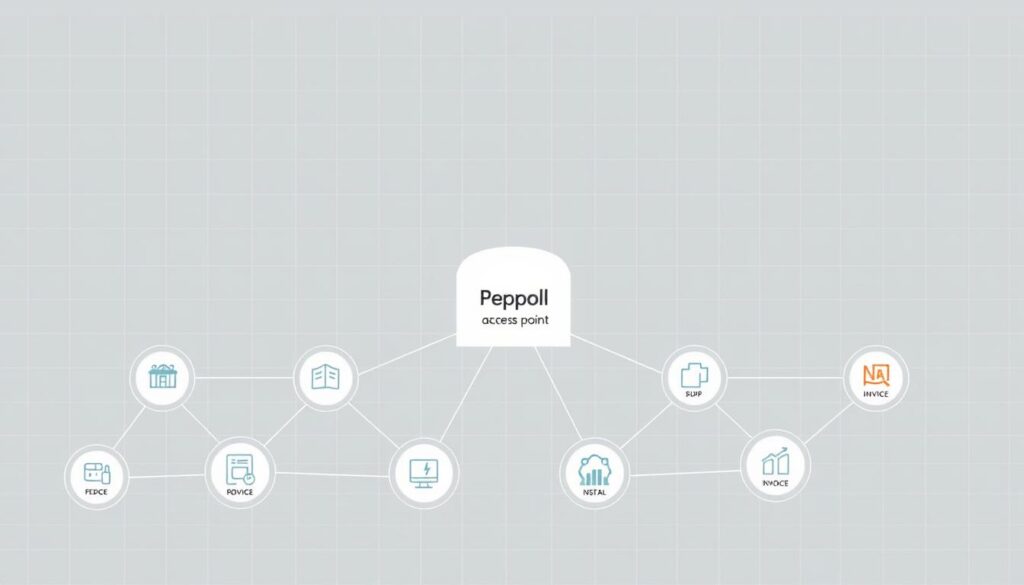
How Peppol works: standards, accredited service providers, and cross-border exchange
Peppol is an enabler, not a marketplace. Accredited providers implement the specifications and handle routing, certificates, and participant IDs. This means you can exchange invoices reliably across borders without changing core systems.
“Standardized messages reduce integration cost and make cross-border document exchange operationally consistent.”
Integrating with accounting software and ERP systems
We map your accounting and erp landscape to Peppol endpoints so your current software handles document creation and posting. Providers configure transformations, validations, and routing to meet local rules.
- Architecture briefing: message structures, participant identifiers, and transport layers.
- Integration plan: endpoints, certificates, and routing with your software erp vendors.
- Test strategy: unit, integration, and UAT to validate flows, acknowledgments, and exceptions.
- Operational controls: logging, SLA monitoring, and support runbooks for partner onboarding.
| Area | What it delivers | Benefit for you |
|---|---|---|
| Standards & Transport | Peppol documents, profiles, security | Consistent format; secure cross-border exchange |
| Provider Role | Routing, certs, endpoint management | No portal swap; existing systems remain |
| Integration | Connector mapping, validation rules | Fast configuration with current accounting systems |
| Operations | Logging, runbooks, SLA checks | Audit-ready, resilient exchange processes |
mdec e invoice Support Services: Advisory, Implementation, and Compliance
We deliver focused advisory and hands-on implementation to make your transition to standardized electronic document exchange predictable and auditable.
Our readiness review inventories your systems, data models, and process flows. We identify gaps and remediation actions so you have a clear baseline.
Readiness assessment: systems, data, and process mapping
We map your IT landscape, accounting platforms, and operational processes. This creates test cases for AR and AP and highlights master data fixes.
Solution implementation: configuration, software selection, and provider coordination
We craft an implementation plan that sequences configuration, testing, and provider onboarding. Providers are coordinated for connectivity, SLAs, and support models.
Compliance alignment: tax reporting requirements and LHDNM guidelines
We align controls to local tax rules and map reporting needs into document flows, reconciliations, and retention policies. This ensures audit readiness and legal compliance.
Enablement: training, knowledge transfer, and ongoing technical support
We deliver role-based training and knowledge transfer so your teams sustain the solution after go-live. Ongoing support covers monitoring, incident response, and continuous improvement.
- Baseline: systems and data inventory to reduce surprises.
- Plan: sequenced implementation and testing to protect continuity.
- Validate: accounting integrations and tax coding for accurate posting.
- Support: provider coordination and stakeholder engagement through the journey.
Grants, Incentives, and Digitalisation Programmes You Can Leverage
We help companies identify grants and incentives that reduce the cost of digital transformation and speed technology adoption.
Funding landscape: Malaysia Digital programmes and support
Malaysia Digital (MD) frames national initiative aims to grow the digital economy. Promoted sectors include Digital Trade and Digital Finance.
MD Status offers tax relief and import duty or sales tax exemptions for approved activities. Catalytic programmes such as PeMangkinMD include the National E‑Invoicing Initiative.
Eligibility, documentation, and application support
We simplify access by listing eligibility rules, required documents, and application timelines. This saves your teams administrative time.
We align proposals to sector priorities so opportunities look relevant and compelling to assessors. We also coordinate with providers to evidence technical readiness.
| Programme | What it supports | Key benefit |
|---|---|---|
| MD Status incentives | Approved digital activities, tax and duty exemptions | Lower capital and operating cost for technology |
| PeMangkinMD catalytic grants | Pilot projects and scaling of digital trade tools | Funding for proof-of-concept and market access |
| Industry outreach & workshops | Training, compliance guidance, provider introductions | Faster adoption and reduced implementation risk |
“We map funding to your roadmap, preparing documentation and KPIs so funding supports measurable outcomes.”
Business Outcomes: Efficiency, Control, and a Stronger Digital Trade Ecosystem
Clear digital trails and standardized exchanges reduce disputes and accelerate collections across your trading network. These operational changes deliver measurable benefits for finance teams and trading partners.

Operational efficiency and cash flow improvements
Standardized documents cut manual data entry and simplify matching. That drives shorter cycle times and higher straight-through rates across AP and AR.
Faster issuance and fewer disputes means improved cash flow and predictable receivables performance.
Data integrity, audit readiness, and regulatory alignment
Digital validation and secure trails strengthen data quality for reconciliations and financial close. This improves auditability and reduces ad hoc work at period end.
We translate regulations into daily control points so compliance is embedded in your processes rather than a last-minute task.
Supply chain visibility and sustainability gains
Standard exchanges increase visibility across your supply network. That supports better fulfillment, exception handling, and partner collaboration.
Going paperless lowers costs and environmental impact while improving document search and retention for long-term governance.
- Quantified outcomes: shorter cycle times and higher straight-through rates.
- Cash: faster collections from standardized invoices and improved matching.
- Resilience: clear ownership, SLAs, and monitoring for continuous improvement.
These outcomes align with national digital priorities and help Malaysian businesses participate in a stronger, more efficient digital trade ecosystem.
Who We Help: Malaysian Businesses Across Sectors and Systems
We enable smooth adoption for companies by mapping standard exchanges to each organisation’s current systems. Our focus is on practical, low-disruption change so your teams can keep operating while modernising document flows.
From SMEs to enterprises using diverse accounting and ERP software
We support malaysian businesses from high-growth SMEs to large enterprises with multi-entity, multi-system environments.
- Services scale for businesses with complex approval matrices, shared service centres, and multi-country operations.
- Companies gain from a vendor-agnostic approach that protects existing investments and avoids re-platforming.
- We integrate with accounting, ERP, procurement, and AP automation software to streamline end-to-end flows.
- Industry-aware templates accelerate delivery for manufacturing, distribution, financial services, and professional services.
- Our approach balances standardization with flexibility so local controls and process nuances remain intact.
- We align IT and finance on security, performance, and support models suitable for your risk profile.
- Training targets both business and technical teams to secure sustained adoption beyond rollout.
How to Get Started: Your E‑Invoicing Journey, Step by Step
Begin your journey with a readiness workshop that aligns leadership on scope, milestones, and governance tied to national timelines. This creates clear decision points and confirms resources before technical work begins.
We formalize an implementation plan that maps dependencies across IT, finance, and trading partners. That plan reduces execution risk and schedules provider coordination around mandated dates.
Adoption accelerates through pilot waves that validate connectivity with providers, message mappings, and exception handling. Pilots use real transactions so you see how the process performs in practice.
We document process flows and control points to ensure segregation of duties from day one. Accounting mappings and tax configuration are verified end-to-end so GL impacts and subledgers reconcile seamlessly.
Our goal is to cut manual data entry by automating validations, codifications, and digital acknowledgments across AR and AP. Invoices are tested at volume with partner traffic to validate throughput, latency, and recovery.
- Readiness workshop to align leadership and scope
- Formal implementation plan with dependencies and providers
- Pilot waves, volume testing, and automation to remove manual steps
- Monitoring, support playbooks, and KPIs for steady-state operation
Conclusion
We help organisations convert national initiative aims into practical, repeatable invoicing operations that scale. By aligning people, process, and technology, your business can operationalize invoicing at volume while meeting tax and compliance timelines.
Our framework‑first approach links your software and erp to accredited providers so solutions remain robust and supportable. Tight implementation and adoption controls reduce manual data entry, speed collections, and raise efficiency.
We provide compliance playbooks, enablement materials, and guided access to funding so companies capture benefits from the digital economy. Engage our team to map next steps and implement a solution that fits your risk, scale, and timeline.
FAQ
What grants and digitalisation programmes can help my business adopt national e-invoicing?
Several government and agency-led funds support digital adoption, including grants for software, integration, and training. We assess eligibility, prepare documentation, and guide applications so you secure funding for Peppol connectivity, ERP adaptations, and staff enablement.
How does the national e-invoicing initiative affect Malaysian businesses?
The initiative mandates interoperable electronic invoice exchange to improve tax transparency and trade efficiency. It sets timelines for high-value transactions first, then wider adoption. Businesses must align systems and processes to meet reporting and exchange standards without replacing core ERPs.
Who governs interoperability and who handles tax compliance?
A national authority oversees Peppol interoperability and accreditation of access points, while the tax authority remains responsible for tax reporting and compliance. We help bridge both areas so your technical setup meets interoperability rules and your reporting aligns with LHDNM requirements.
What are the key implementation steps to connect my accounting system to Peppol?
The typical steps are readiness assessment, mapping invoice data, selecting an accredited provider, configuring your ERP or accounting software, testing exchanges, and rolling out with training. We coordinate with vendors to minimise disruption and ensure smooth integration.
Will implementing Peppol force us to replace our ERP or accounting software?
No. Peppol is designed to interoperate with existing ERPs via connectors or middleware. We evaluate your current system, recommend the least disruptive integration path, and implement adapters so you can exchange invoices without a full system overhaul.
How do we ensure compliance with tax reporting while using Peppol?
Compliance requires correct invoice data, retention policies, and timely submissions per tax rules. We align your invoice schema, audit trails, and reporting workflows with LHDNM guidance and perform validation tests to reduce risks during audits.
What cost savings and operational benefits can we expect from adoption?
Benefits include reduced manual data entry, faster invoice processing, improved cash flow, fewer errors, and stronger supply chain visibility. Over time, automation lowers processing costs and supports better financial controls and audit readiness.
Who should start the e-invoicing project internally and what roles are needed?
A cross-functional team works best: finance, IT, procurement, and compliance. Executive sponsorship ensures resources and change management. We provide role-based training and templates to simplify governance and user adoption.
Are there eligibility criteria for digitalisation funding and grants?
Yes. Criteria vary by programme but commonly consider company size, revenue, project scope, and alignment with national digital agendas. We screen your eligibility, prepare supporting documents, and manage the submission process to improve approval chances.
How long does a typical implementation take from assessment to live exchange?
Timelines vary with complexity. Small firms with cloud accounting can go live in weeks; larger enterprises with customised ERPs may need months. Our phased approach prioritises quick wins and phased rollouts to deliver value early while managing risk.
What training and post-implementation support do you provide?
We deliver role-specific training, user guides, and knowledge-transfer sessions. Post-go-live, we offer technical support, monitoring, and periodic reviews to ensure continued compliance and software updates are handled smoothly.
How do we choose an accredited access point or service provider for invoice exchange?
Choose providers based on accreditation status, integration capabilities, security, service levels, and cost. We vet vendors, run proof-of-concept tests, and negotiate contracts so you get reliable connectivity and clear support SLAs.
Can e-invoicing improve supply chain sustainability and visibility?
Yes. Electronic exchange removes paper, reduces processing times, and centralises invoice data for analytics. That improves supplier collaboration, reduces carbon footprint, and supports sustainability reporting across the supply chain.
What data and document retention practices should we adopt?
Retain invoice records per statutory periods and maintain secure, auditable storage with easy retrieval. We implement retention policies, backup routines, and access controls to meet regulatory and audit requirements.
How do you handle cross-border invoice exchanges under the Peppol framework?
Peppol supports standardised, cross-border invoice exchange via accredited access points. We ensure your documents meet international message standards and coordinate with foreign partners or providers to facilitate seamless trade and compliance.
What are common risks during migration and how do you mitigate them?
Risks include data mapping errors, integration failures, and resistance to change. We mitigate these through thorough assessments, staged testing, stakeholder engagement, and contingency plans to keep operations uninterrupted.
How do small and medium enterprises benefit differently from larger firms?
SMEs gain rapid cost reductions, faster payments, and simplified compliance; larger firms benefit from scale, improved controls, and supplier network efficiencies. Our services scale to match your size and system complexity.
What documentation do you need to begin a readiness assessment?
We typically request current invoice samples, chart of accounts, ERP/system access details, process maps, and any existing compliance or audit records. This lets us provide an accurate roadmap and cost estimate.
How do we measure success after going live with electronic invoice exchange?
Key metrics include invoice cycle time, error rates, days payable outstanding, cost per invoice, and compliance incident reductions. We set baseline metrics during assessment and track improvements post-implementation.