Small and medium businesses face a fast-moving shift in how they handle tax documents. The Inland Revenue Board (IRBM) began a phased e-invoicing rollout on August 1, 2024 to modernize tax administration.
The new system links directly to LHDN for real-time validation, so every sale can be verified as it happens. This is not just a digital upgrade — it is a mandatory compliance step that affects daily accounting and reporting.
Understanding the relationship between service tax and the e-invoice format helps businesses avoid errors and penalties. Adopting e-invoicing malaysia improves transparency, speeds up reconciliation, and reduces manual work for finance teams.
Key Takeaways
- The IRBM launched phased e-invoicing to modernize tax reporting.
- LHDN integration enables real-time validation of transactions.
- e-Invoicing is a mandatory compliance requirement for businesses.
- Adoption boosts transparency and cuts manual reconciliation time.
- Understanding service tax rules with the new process is essential.
Understanding the Shift from Traditional Invoicing
Many firms still rely on paper invoices, and that choice creates friction across accounting and payment cycles. Manual entry leads to simple errors, lost documents, and added time for reconciliations.
Limitations of paper invoicing show in everyday costs and delays. Printing, postage, and storage add up. Staff spend hours correcting typos and chasing missing bills.
The rise of digital automation changes this. Modern accounting systems generate e-invoices automatically and store them securely. This reduces the risk of loss and creates clear audit trails.
Automated processes also speed payment cycles. Faster invoicing means healthier cash flow and fewer disputes with clients. Integrating advanced software captures transactions accurately and supports compliance.
Key operational differences
- Paper: Higher error rates, longer processing time.
- Digital: Secure storage, faster reconciliation.
- Automated invoicing: Lower administrative costs and quicker payment.
“Switching to e-invoices cuts manual work and strengthens auditability across the finance team.”
| Aspect | Paper Invoices | Digital Invoicing | Business Impact |
|---|---|---|---|
| Accuracy | Prone to human errors | System-validated entries | Fewer corrections, less rework |
| Storage | Physical files, risk of loss | Encrypted electronic archives | Lower storage cost, better security |
| Payment Cycle | Slower due to manual handling | Faster with automated delivery | Improved cash flow |
| Compliance | Harder to track | Clear audit trail for tax and service records | Easier reporting and fewer penalties |
Core Differences Between SST vs e-Invoice Malaysia
Real-time tax validation reshapes how businesses record and report sales. The new e-invoicing malaysia model makes validation an active step before an invoice is shared with the buyer.
The main contrast is that traditional sst focused on manual tracking and post-event reporting. The current system mandates instant checks with LHDN so every transaction is validated as it occurs.
The integration captures sales data centrally. That reduces mismatches during audits and creates a clear, traceable audit trail for services and goods.
- Mandatory real-time validation replaces manual SST entries.
- Automated e-invoicing improves accuracy for transactions and tax reporting.
- Standardized invoice formats boost transparency across the supply chain.
“Businesses must update internal processes to meet real-time validation — it’s compliance, control, and clarity rolled into one.”
In short, firms that align systems and staff with the new rules gain smoother reconciliation and stronger tax compliance supported by LHDN integration.
The Mechanics of the LHDN Validation Process
A clear, step-by-step flow governs how an e-invoice moves from the supplier to the buyer through LHDN.
Generation
The generation stage begins when a supplier creates an invoice in their accounting system. It must include all mandatory data fields and meet the LHDN requirements.
Validation
After creation, the e-invoice is sent to the LHDN platform for real-time validation. The system checks tax codes, amounts, and transaction details to reduce common errors.
On success, LHDN issues a unique identifier. That ID must appear on the invoice before it goes to the buyer.
Delivery
Delivery sends the validated invoice to the buyer and stores a traceable record on the platform. This step makes the payment cycle transparent and lowers fraud risk.
- Supports credit notes and adjustments under the same validation rules.
- Automated integration with business systems keeps reporting accurate and timely.
- Overall, the process streamlines invoicing, strengthens compliance, and protects both parties.
“Real-time validation cuts reconciliation time and creates a single source of truth for transactions.”
Mandatory Implementation Timeline for Businesses
Timetables for mandatory e-invoicing rollouts are set by turnover bands so firms can prepare in stages.
Large taxpayers with annual revenue above RM100 million began their move on 1 August 2024. This first phase required early adapters to update systems and train staff.
Subsequent phases bring more businesses into the system over time. Phase 4 covers firms with turnover up to RM5 million and has an extended relaxation until 31 December 2027. This gives smaller firms extra time for implementation.
Practical steps help avoid penalties and ensure smooth operations.
- Verify sales and transaction records are ready for validation.
- Update accounting tools so every invoice and e-invoice meet LHDN rules.
- Plan staff training to maintain tax compliance and correct service tax reporting.
Staying on schedule means buyers receive valid, compliant documentation and your business avoids late fines. Treat the phased approach as a chance to improve processes rather than a deadline squeeze.
“Proper planning for the timeline helps companies avoid penalties and keeps transactions flowing.”
Comparing Malaysian E-Invoicing with International Models
When comparing regional e-invoicing frameworks, the balance between regulatory validation and B2B efficiency becomes clear.
Singapore’s InvoiceNow uses the PEPPOL network to speed document exchange between trading partners. Its goal is smoother supply chains and faster invoice delivery for businesses.
The Singaporean PEPPOL Approach
PEPPOL focuses on standardised message formats and connection points. It helps firms trade electronically without forcing a direct tax link.
In contrast, the malaysia e-invoicing model mandates real-time validation with the tax authority. That creates stricter oversight of each transaction and the final e-invoice sent to a buyer.
- Singapore: prioritises B2B connectivity and efficiency.
- Malaysia: emphasises immediate tax validation and compliance.
- Cross-border firms must align their implementation and integration strategies with local rules.
| Feature | Singapore (PEPPOL) | Malaysia | Business impact |
|---|---|---|---|
| Tax authority link | No direct real-time check | Mandatory real-time validation | Clearer compliance in Malaysia |
| Main focus | B2B exchange efficiency | Regulatory validation | Different integration needs |
| Effect on transactions | Faster document flows | Stronger oversight per transaction | Longer setup time, fewer audit gaps |
| Buyer experience | Seamless receipt of invoices | Receives tax-validated e-invoices | More trust, less reconciliation time |
“Understanding both models helps businesses plan systems that meet local tax rules while keeping trade efficient.”
Essential Data Fields for Compliance
LHDN expects a tight set of data points on every electronic invoice to accept it for tax reporting.
The full e-invoice format lists 55 fields, with 37 flagged as mandatory for successful validation.
Key entries include supplier and buyer names, tax identifiers, the tax amounts and any service tax applied, a clear description of goods or services, and the total amount payable.

- Include all 37 mandatory fields exactly as defined by the LHDN taxonomy to avoid rejection.
- Provide accurate supplier and buyer details so each transaction links to real sales records.
- Record correct tax amounts and service details to meet tax and compliance checks.
- List the precise description and the total amount for each invoice or credit adjustment.
Credit notes and other adjustments must follow the same field rules to be recognised. Properly managed fields reduce audit friction and help businesses keep clean, verifiable records.
“Standardising invoice fields turns messy paperwork into reliable, auditable transactions.”
Assessing Your Business Readiness
A realistic readiness check begins with mapping every invoicing step from order to payment and spotting weak links. This quick map shows where your systems must meet new requirements and where staff need training.
Evaluating Internal Systems
Start by testing your accounting software for the exact data fields required by real-time validation. Check integrations between sales, inventory, and finance modules so transactions flow without manual fixes.
Run a gap analysis to find missing fields or export limits. If your system cannot produce compliant e-invoices, plan a software update or connector before deadlines.
Training Your Workforce
Train teams on new processes and their compliance obligations. Focus on data entry standards, how to handle rejected invoices, and when to notify a buyer or customer.
Clear communication with suppliers and customers lowers implementation risk. A well-prepared team plus reliable software supports smooth adoption and better tax management.
“Proactive checks, targeted training, and the right software reduce disruption and keep operations steady.”
Navigating SST Adjustments and Self-Billing Risks
Self-billing can speed processing, but it also moves compliance responsibility to the buyer under the new e-invoice malaysia framework.
From 1 January 2026, rental and leasing services saw a reduction in the service tax rate from 8% to 6%. At the same time, the MyPMK tenant exemption threshold rose to RM1.5 million.
These changes mean your business must update its accounting system so invoices capture the correct service tax amount and date.
The buyer now carries the burden of proof in self-billing arrangements. The platform logs timing and transaction details, so any mismatch is easy for authorities to trace.
- Keep valid exemption certificates and link them to each transaction.
- Record every credit note and payment with clear amounts and dates.
- Review supplier agreements to confirm who issues the invoice and who keeps records.
“Accurate records and aligned processes reduce audit risk and protect companies from penalties.”
| Issue | Action | Benefit |
|---|---|---|
| Rate change (rent/lease) | Update tax codes in system | Correct tax collection and reporting |
| Self-billing liability | Assign proof duties and document approvals | Fewer disputes with LHDN |
| Exemption claims | Store certificates with invoices | Faster audit resolution |
Choosing Between the MyInvois Portal and API
Consider whether your business needs a no-frills upload tool or a background integration that sends every invoice automatically.
The MyInvois Portal is free, government-hosted, and ideal for MSMEs with lower volumes. It meets basic e-invoice requirements and lets staff upload and manage invoices without extra software.
API integration connects your accounting systems directly to the LHDN platform. This is the best solution for large firms that handle many transactions and need automated validation and minimal manual work.
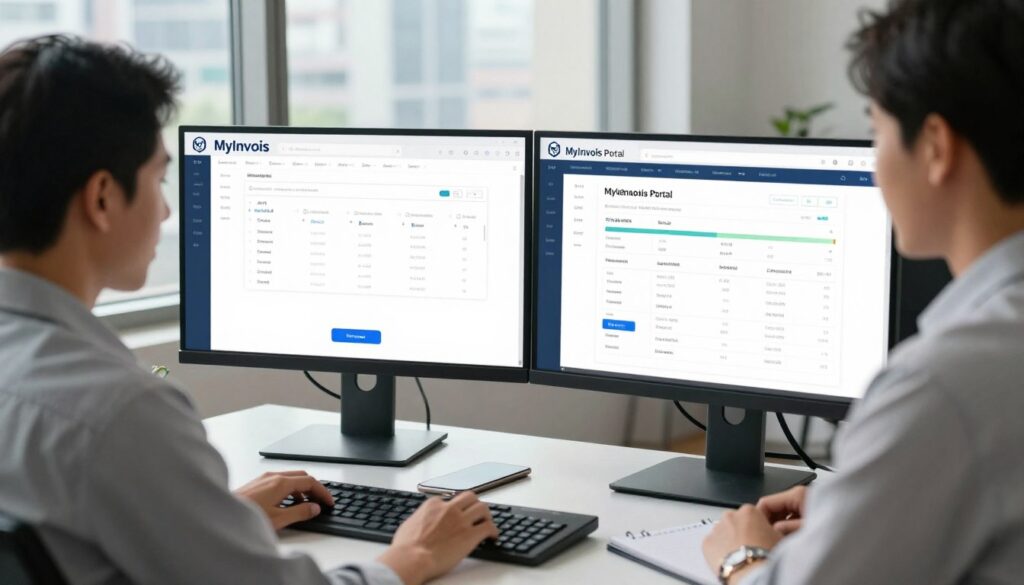
- Portal: cost-effective, manual uploads, good for low volume.
- API: automated transmission, reduced errors, scales with transaction load.
- Both: enforce mandatory fields and data standards for tax validation.
“Pick the path that matches your current systems and long-term compliance goals.”
| Feature | MyInvois Portal | API Integration |
|---|---|---|
| Best for | MSMEs with low volume | Large enterprises with high volume |
| Setup | Quick, no software needed | Requires development and testing |
| Automation | Manual uploads | Direct, real-time transmission |
| Impact on tax & validation | Meets requirements, manual checks | Streamlines validation and reporting |
Strategic Benefits of Digital Transformation
A clear digital strategy turns invoicing from a cost centre into a tool for better cash management.
Automating invoicing improves invoice accuracy and streamlines tax filing for businesses of every size. Fewer manual entries mean lower error rates and faster reconciliation.
Digital records speed up payment cycles and reduce disputes. Faster payments support healthier cash flow and simplify sales forecasting.
Security and insight are another advantage. Centralised data gives management clear views of payment trends and customer behaviour.
Adopting one software platform cuts paper costs and helps meet service tax rules. It also lowers operational risk by protecting sensitive transaction details.
“Moving to a digital platform lets businesses scale operations while keeping compliance and control.”
| Benefit | What it delivers | Business impact |
|---|---|---|
| Accuracy | Validated invoice fields and fewer manual fixes | Lower audit risk and faster closing |
| Cash flow | Quicker payment cycles and clearer sales timing | Improved working capital |
| Security | Encrypted records and access controls | Reduced fraud risk and safer data |
| Scalability | Automated processes and API-ready platforms | Easier growth and consistent compliance |
Conclusion
A practical approach to implementation reduces risk and keeps cash flow steady during the transition. For many small and medium businesses, this shift affects daily accounting and tax routines. Embrace e-invoicing to cut manual work and speed reconciliation.
Focus on clear steps: map processes, pick reliable software, and train staff. Meeting LHDN rules early helps secure long-term tax compliance and avoid penalties linked to incorrect e-invoice records.
Remember the change touches both SST reporting and wider operations. Companies that plan now will see better accuracy, faster payments, and stronger financial control. Start a readiness check today to ensure a smooth, compliant rollout.
FAQ
What is the main difference between SST accounting and electronic invoicing for Malaysian small businesses?
The core difference lies in purpose and process. One is a tax regime requiring accurate sales and service tax reporting; the other is a digital method to issue, validate, and store invoices electronically. Digital invoicing automates data capture, reduces manual errors, and streamlines tax reporting, helping firms meet tax obligations faster and keep better records for audits.
How does the LHDN validation process work for digitally issued invoices?
The process has three parts: generation of the invoice by the supplier, submission to the LHDN validation endpoint for real-time schema and field checks, and delivery of a validated invoice to the buyer. Validation confirms required fields, tax calculations, and unique identifiers to ensure compliance before the transaction is final.
What are the mandatory data fields my accounting system must include for compliance?
Systems must capture seller and buyer legal names, tax registration numbers, invoice number and date, line-item descriptions, taxable amounts, tax type and rate, total payable, payment terms, and digital signature or validation token. These fields support accurate tax reporting and LHDN validation.
When does mandatory implementation start for businesses and who must comply first?
Implementation follows a staged roll-out based on business size and turnover thresholds. Large taxpayers and high-volume service sectors typically adopt first, followed by medium and small enterprises. Check current LHDN timelines and guidance for exact dates and enrollment windows.
Can I use the government portal instead of integrating via API?
Yes. The MyInvois portal allows manual creation, validation, and storage of invoices, suitable for low-volume users. API integration is better for automated, high-volume operations and direct connection with accounting or ERP systems to reduce human intervention and errors.
What integration options are available for my existing accounting software?
You can choose direct API integration, middleware connectors from accounting vendors, or third-party e-invoicing platforms that map your invoicing fields to the government schema. Many providers support JSON or XML formats and offer SDKs, webhooks, or batch upload tools to fit different system architectures.
How will digital invoicing affect my sales and payment processes?
Digital invoices accelerate invoice issuance and validation, improving cash flow visibility and reducing disputes from missing or incorrect data. Faster validation can shorten payment cycles because buyers receive compliant invoices promptly, and automated reconciliation reduces manual bookkeeping.
What risks should I watch for when implementing self-billing arrangements?
Self-billing shifts invoicing responsibility to the buyer, which can create disputes over amounts, tax treatment, and record ownership. Ensure contractual clarity, aligned data fields, proper authorization, and audit trails. Confirm the arrangement complies with tax rules to avoid assessment risks.
How do international models like Singapore’s PEPPOL compare to the Malaysian approach?
PEPPOL uses a standardized network for secure document exchange across borders with strict interoperability rules. The Malaysian model focuses on real-time validation by tax authorities and local compliance fields. Cross-border trading may require mapping between standards and additional data fields to meet both regimes.
What internal changes should my business make to prepare for e-invoicing?
Evaluate and upgrade accounting and ERP systems, map required data fields, define invoice numbering and approval workflows, train staff on new processes, and test end-to-end submission and validation. Establish change management and backup procedures to maintain continuity during transition.
Does digital invoicing eliminate the need for paper records?
Electronic records can replace paper if they meet retention and authenticity standards set by tax authorities. Maintain secure backups and access controls. Some businesses may keep limited paper copies for legacy reasons, but digital storage simplifies retrieval, audits, and compliance.
How will e-invoicing affect error rates and audit readiness?
Automation reduces manual entry mistakes and enforces consistent data validation, lowering error rates. Structured digital records and validation tokens improve audit trails, making it easier to demonstrate compliance during tax reviews and reducing the risk of penalties.
What training should staff receive before rollout?
Train accounting, sales, and IT teams on invoice creation, required fields, validation errors, submission procedures, and reconciliation. Include guidance on handling exceptions, dispute resolution, and using the portal or integrated tools so everyone understands their role.
Are there additional costs tied to adopting digital invoicing?
Costs include software upgrades, integration work, possible subscription fees for third-party platforms, and staff training. However, many businesses recover costs through reduced processing time, fewer errors, faster payments, and lower audit risk.
How should my business handle transitional SST adjustments during the changeover?
Review outstanding invoices, credit notes, and service contracts to determine correct tax treatment under the new system. Amend or reissue documents where necessary, keep clear records of adjustments, and communicate changes to customers and suppliers to avoid disputes and compliance gaps.