The Inland Revenue Board of Malaysia launched a mandatory e-invoice scheme on 1 August 2024. This move modernized tax reporting and shifted business billing toward digital proof of transactions.
Every e-invoice must follow IRBM XML or JSON rules and include 55 required fields. The format lets systems validate invoices in real time, cutting manual mistakes and speeding audits.
For many companies, these electronic records replace paper bills. Adopting e-invoices helps streamline accounting and keeps firms aligned with government tax rules.
Key Takeaways
- The IRBM made e-invoicing mandatory from August 1, 2024.
- E-invoice files must use specified XML or JSON formats with 55 fields.
- Real-time validation reduces errors and boosts transaction transparency.
- Digital invoices act as formal proof for commercial activity.
- Using e-invoices streamlines finance workflows and ensures compliance.
Understanding the Digital Tax Landscape in Malaysia
Malaysia’s tax landscape shifted sharply when the Inland Revenue Board started rolling out mandatory digital billing on 1 August 2024. This phased implementation aims to strengthen the digital economy and improve tax compliance across sectors.
The Inland Revenue Board has launched a comprehensive transformation so that all businesses operate under a unified, transparent framework. e-invoicing malaysia becomes the primary channel for the Revenue Board to monitor commercial activity.
Companies must update processes and systems to meet the new invoicing format and data-sharing rules. Real-time reporting helps the inland revenue detect discrepancies faster and reduces manual checks.
- Unified monitoring: a single standard for records.
- Better oversight: faster data flow to the revenue board.
- Clear duty: businesses must align internal controls for tax compliance.
Export Sales and e-Invoice in Malaysia: What Exporters Need to Prepare
Proper documentation now centers on validated digital records for every international shipment.
Issuing a compliant e-invoice for transactions with foreign buyers is mandatory. This ensures proof for tax purposes and speeds customs checks.
Defining Export Documentation
Each invoice must list accurate details for suppliers and buyers, item descriptions, and value. Systems should capture this data at source.
Compliance for Global Trade
Integrate systems with IRBM’s digital infrastructure so invoices validate in real time. That reduces delays at ports and audits later.
- Issue a validated e-invoice for every foreign transaction.
- Store complete buyer/supplier details for audit and customs clearance.
- Keep records ready for tax purposes and cross-border verification.
| Requirement | Why it matters | Action |
|---|---|---|
| Validated e-invoices | Proof for tax purposes and customs validation | Automate issuance at point of sale |
| Complete buyer/supplier data | Supports audits and shipment checks | Use standardized data fields |
| System integration | Real-time validation with IRBM | Connect via API or MyInvois portal |
| Retention policy | Legal and compliance needs | Archive digital records securely |
Determining Your Business Implementation Timeline
Map your migration steps now so invoicing processes don’t disrupt daily operations.
Start by confirming your annual turnover band. Phase 4 entities with turnover up to RM5 million have an extended interim relaxation until 31 December 2027. The legal mandatory date for all businesses remains 1 January 2026, while full penalty enforcement begins 1 January 2028.
Review how these dates affect cash flow and payment cycles. Small firms gain extra time, but delayed action can still hurt collections and supplier terms.
- Check annual turnover to set your timeline and meet IRBM requirements.
- Prepare your accounting system to generate an e-invoice by the required deadline.
- Plan testing and staff training so e-invoices flow without interrupting payments.
By the end of the designated transition month, ensure your digital infrastructure is live and compliant. That protects cash flow and avoids late-adoption penalties.

Core Components of the MyInvois System
The MyInvois system blends a web portal with API options so businesses can submit compliant records quickly. This dual approach reduces manual work and speeds tax reporting.
MyInvois Portal Features
The myinvois portal lets teams upload and review invoices manually. It suits lower-volume users and those needing a simple interface for each transaction.
Validation happens at submission, so suppliers see errors before sending. That lowers rejects and keeps records tidy.
API Integration Benefits
APIs connect accounting software directly to the revenue board. High-volume businesses gain efficiency through automated invoicing and fewer touchpoints.
Data Validation Standards
The system enforces real-time validation of 37 mandatory fields. Meeting these data requirements is critical to avoid rejections during automated checks.
| Component | Main Benefit | Key Notes |
|---|---|---|
| Portal | Easy manual submission | Good for low-volume operations; immediate feedback |
| API | Automated, high-speed transmission | Reduces manual steps; ideal for large businesses |
| Validation | Ensures compliant e-invoices | Real-time checks of 37 fields; aligns with inland revenue board rules |
| Records | Secure archiving | Supports audits and supplier details retention |
Managing Cross-Border Transactions and Self-Billed Invoices
Handling imported goods or services means local parties must create clear digital records when foreign suppliers do not issue local paperwork. This ensures tax rules are met and customs checks go smoothly.
Rules for imported goods and services
Rules for Imported Goods and Services
When customs clearance is complete, the Malaysian purchaser must issue a self-billed e-invoice by the end of the following month. This timing protects the business for tax purposes.
The Royal Malaysian Customs and the Inland Revenue Board require at least one local party in each cross-border transaction. That local party documents the cost and issues self-billed e-invoices when needed.
- Malaysian purchasers create records for expenses from a foreign supplier.
- Self-billed e-invoices must be generated by the end of the month after customs clearance.
- Maintain accurate data for imported services so every transaction validates for tax purposes.
| Requirement | Who is responsible | Why it matters |
|---|---|---|
| Self-billed e-invoice timing | Malaysian purchaser | Ensures tax compliance after customs clearance |
| Local party presence | At least one local entity | Meets Royal Malaysian Customs and IRB rules |
| Accurate transaction data | Businesses’ accounting system | Supports audits and customs clearance |
| Documentation for imported services | Malaysian purchaser | Validates costs for tax purposes |
Essential Steps for System Readiness and Data Mapping
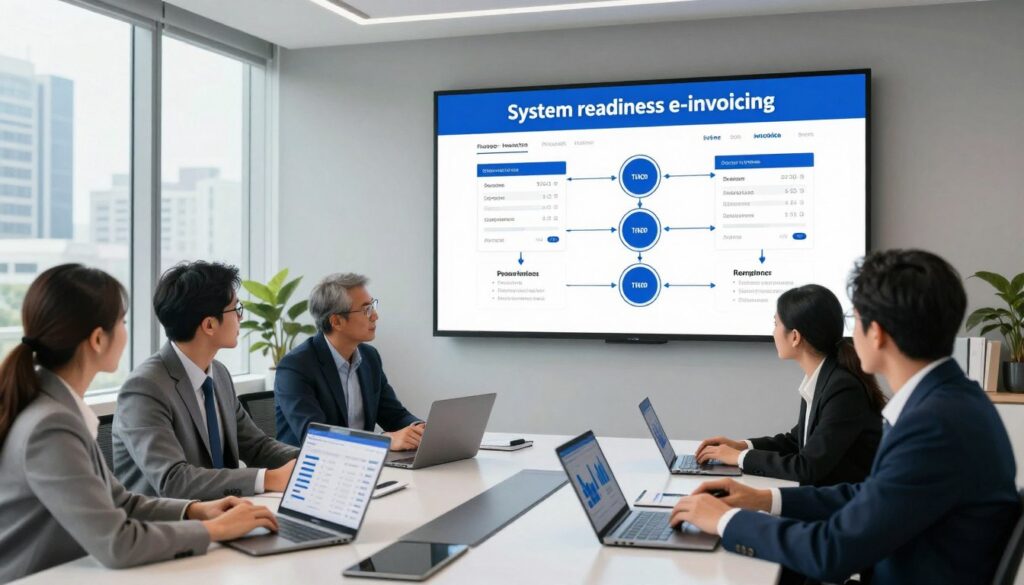
Start system readiness by inventorying every invoice field and matching it to the MyInvois schema. This first task prevents routine validation errors during live submission.
Conduct a gap analysis to spot missing or mismatched data. Fix field formats, code lists, and mandatory entries before testing.
Map internal records to the IRBM taxonomy so each e-invoice transmits required details for audits and customs clearance. Proper mapping supports smooth interaction with the myinvois portal and myinvois system.
Run staged tests with sample invoices. Validate outputs against the customs department rules used by the royal malaysian customs and the malaysian customs department to ensure acceptance.
| Step | Why it matters | Key action |
|---|---|---|
| Field mapping | Prevents validation failures | Match each internal field to IRBM taxonomy |
| Gap analysis | Reveals process weaknesses | Correct formats and missing data |
| Testing | Confirms live readiness | Send sample e-invoices via portal or API |
| Verification | Ensures customs clearance | Check against royal malaysian customs rules |
Handling Foreign Currency and Exchange Rate Requirements
From 31 March 2026, every foreign-currency invoice must show the equivalent amount in MYR using an approved exchange rate. This rule ensures clear figures for tax checks and customs verification.
The “Currency Exchange Rate” field is mandatory on all e-invoices that use a foreign denomination. Missing or incorrect rates will trigger validation rejects and slow processing.
When handling cross-border transactions, the malaysian purchaser should source rates from an approved reference such as Bank Negara Malaysia. Record the exact reference and date used with each transaction.
Apply the same exchange rate consistently for multiple transactions within the same month. Consistency helps maintain accurate financial records and reduces reconciliation work.
- Include the foreign supplier’s details and the MYR equivalent on every e-invoice.
- Ensure the currency field and rate match approved sources to meet service tax requirements.
- Consistent monthly application prevents data mismatches and validation errors.
“Accurate exchange-rate reporting speeds validation and protects businesses from late adjustments.”
Operational Advantages of Adopting Digital Invoicing
Automated invoicing lets teams spot discrepancies earlier and close books faster. This lowers errors from manual entry and improves overall financial reporting.
Improving Financial Reporting Accuracy
Digital records capture each transaction with consistent fields and timestamps. That consistency cuts reconciliation time and reduces mismatches during audits.
Automating creation and submission of every e-invoice means ledgers match source documents more often. Management gains clearer reports for tax reviews and planning.
Enhancing Cash Flow Cycles
Faster validation speeds approval and shortens days sales outstanding. Companies see quicker payment arrival and fewer disputes over details.
Streamlined processes free staff to focus on growth. At the same time, automated workflows help maintain tax compliance and reduce service tax calculation errors.
- Real-time data improves decision-making on working capital.
- Automated submission reduces manual rework and missed payments.
- Consistent formats strengthen audit trails for transactions and invoices.
| Advantage | Benefit | Action |
|---|---|---|
| Accuracy | Fewer ledger discrepancies | Automate field mapping |
| Cash flow | Faster payment cycles | Enable real-time validation |
| Compliance | Cleaner tax records | Standardize invoice details |
“Automated e-invoices reduce errors and speed reconciliation.”
Leveraging Professional Support for Seamless Integration
A tailored middleware partner lets firms link internal records to the revenue board faster. Providers such as BDO supply middleware that bridges ERP platforms and the myinvois system. This reduces manual work and speeds validation.
Experts also guide precise data mapping. They ensure every invoice field meets inland revenue board requirements for cross-border transactions. That lowers rejects during live submission.
Specialist teams can automate self-billed e-invoices for the malaysian purchaser. Automation helps keep financial reporting accurate and reduces the risk of missing details needed for tax purposes.
Consultants advise on supplier documentation, buyer records, and payment timing so at least one local party stays compliant. That practical support helps businesses finish implementation on schedule.
- Faster connection: middleware links ERP to the myinvois portal.
- Data accuracy: expert mapping prevents validation errors.
- Audit readiness: automated records support tax compliance.
| Service | Why it helps | Result |
|---|---|---|
| Middleware integration | Connects ERP to revenue board APIs | Faster, automated e-invoice transmission |
| Data mapping | Aligns internal fields with IRBM rules | Fewer validation rejects |
| Compliance advice | Guides self-billed e-invoice timing and supplier records | Audit-ready documentation for tax purposes |
“Professional guidance reduces implementation risk and keeps operations running while compliance work completes.”
Conclusion
Businesses that standardize digital billing gain better control over transaction data and audits. Adopting e-invoicing malaysia marks a major step in the country’s tax modernisation.
Mastering the creation of each e-invoice helps firms meet Inland Revenue Board rules and avoid rework. Focus on accurate field mapping so every invoice validates on first submission.
Proper handling of cross-border transactions keeps customs and tax checks smooth. Clear records for every transaction reduce disputes and speed payments.
Review current processes, run tests, and consult specialists when needed. Companies that prioritise these standards will enjoy better reporting and shorter payment cycles while staying compliant.
FAQ
What is the scope of the new digital tax and invoicing rules in Malaysia?
The rules cover electronic billing requirements for business-to-business transactions and certain cross-border cases. They require suppliers and buyers to transmit structured invoice data through the MyInvois portal or via approved API connections to meet tax and customs reporting. The aim is faster VAT/service-tax verification, improved audit trails, and smoother customs clearance.
Which types of transactions must be reported through MyInvois?
Most commercial supplies of goods and taxable services involving Malaysian purchasers are in scope, including domestic sales, imports of services, and many cross-border supplies where Malaysian tax obligations arise. Self-billed invoices and adjustments that affect tax bases also require declaration. Check Royal Malaysian Customs and the Inland Revenue Board guidance for specific exemptions.
Do foreign suppliers need to register for MyInvois?
Foreign suppliers that have Malaysian tax obligations—such as those required to register for service tax or to withhold taxes—should register or work with a local fiscal representative to submit e-invoices. Where direct registration is impractical, many overseas vendors use local agents or their Malaysian buyers to ensure compliance and accurate reporting.
How should businesses handle self-billed invoices and buyer-issued documents?
Self-billing arrangements must be documented and agreed by both parties. The entity legally responsible for issuing the invoice must send structured data to MyInvois. Buyers issuing invoices on behalf of suppliers must retain agreements and map those documents into their reporting flows for tax and audit purposes.
What data fields are mandatory for each electronic invoice?
Mandatory fields typically include supplier and buyer identification (including tax IDs), invoice number, issue date, description and classification of goods or services, taxable amount, tax rates, currency, and place of supply. Transaction-level identifiers required for customs clearance may also be needed. Follow the MyInvois validation rules to avoid rejection.
How do I manage invoices in foreign currencies and exchange rates?
Record the invoice in the original currency and provide the exchange rate used for tax reporting. Use recognised market rates on the invoice date or the method specified by tax authorities. Ensure your ERP or invoicing system captures both amounts and the exchange rate to meet financial reporting and tax audit requirements.
What are best practices for data mapping and system readiness?
Start with a data inventory of current invoice fields, then map each to MyInvois requirements. Validate sample records end-to-end using a test environment. Keep product and tax codes consistent, implement automated validations, and document exceptions. Engage IT, finance, and tax teams early to reduce surprises during rollout.
Can MyInvois connect with existing accounting or ERP systems?
Yes. MyInvois supports API integration for automated submission and retrieval of invoice statuses. Integrations reduce manual entry, lower error rates, and speed up compliance. If API work is not feasible, consider certified middleware or portal-based batch uploads as interim solutions.
What validation standards will cause invoice rejection?
Common causes include missing tax IDs, invalid invoice numbering, mismatched totals versus line items, unsupported currency codes, and incorrect tax rate application. The portal’s schema and validation engine will flag these, so pre-submission checks and automated validations in your system help prevent rejections.
How long should businesses allow for implementation before the compliance deadline?
Timelines depend on business size and complexity. Small firms with simple billing may need a few weeks to configure and test. Mid-size to large enterprises with multiple systems, foreign transactions, or self-billing setups should plan for several months to map data, integrate APIs, and run user acceptance tests. Start early to allow for supplier and buyer coordination.
Will adopting digital invoicing improve financial reporting and cash flow?
Yes. Structured electronic invoices reduce posting errors, speed reconciliation, and deliver clearer audit trails. Faster invoice validation and automated status feedback can shorten payment cycles. The result is more accurate financial statements and improved working capital management.
When is it necessary to involve professional advisors or certified providers?
Engage tax advisers, customs consultants, or certified integration partners when you have complex cross-border flows, self-billing arrangements, multiple tax regimes, or legacy IT systems. Advisors can help interpret Royal Malaysian Customs and Inland Revenue Board rules, design compliant processes, and manage risk during rollout.
How should businesses handle disputes, credit notes, or invoice cancellations?
Issue structured credit notes or cancellation documents through the same channel as the original invoice, linking them to the initial invoice number and reason code. Maintain records of approvals for disputes and ensure adjustments are reflected in tax returns and customs declarations where relevant.
What records must companies retain for tax and customs audits?
Keep original invoices, e-invoice transmission receipts, audit logs, exchange rate records, and agreements for self-billing or agent arrangements. Retention periods follow tax authority rules; retain digital copies that preserve integrity and allow easy retrieval for inspections.
Where can I find official guidance and technical specifications?
Refer to the MyInvois portal, Royal Malaysian Customs, and the Inland Revenue Board websites for up-to-date technical schemas, user guides, and FAQs. For API documentation, use the developer section on MyInvois and consult certified solution providers for implementation support.