
This article explains the role of the export declaration form and why proof of origin matters to trade.
Since 6 May 2025, the Ministry of Investment, Trade and Industry (MITI) became the main authority issuing origin paperwork for shipments to the United States. This move helps prevent origin washing and keeps documentation consistent with global rules.
The ASEAN Single Window faced a technical disruption from 1 April to 6 April 2026, which briefly slowed digital filings. Companies that keep accurate documents and follow the system process reduce delays at customs and avoid incorrect tariff treatment.
Understanding the form, the service steps, and relevant free trade agreement frameworks gives local firms a competitive edge. Chambers of commerce and trade bodies must update their order and information practices to keep exports moving smoothly.
Key Takeaways
- MITI now issues official origin paperwork for US-bound shipments since May 2025.
- Accurate proof origin helps secure correct tariff treatment and faster clearance.
- ASW disruption in April 2026 highlighted the need for backup processes.
- Use free trade agreement rules to maximize benefits for exported products.
- Chambers of commerce should update procedures to match current application processes.
Understanding the Certificate of Origin Malaysia: Why Exporters Need It for Tax and Customs
A formal origin document proves where exported goods were made or substantially changed, and it guides tariff decisions.
This certificate confirms the country that produced or transformed a product. Importing authorities use that claim to apply duty rates under relevant trade agreements.
Centralizing issuance helped MITI raise verification standards and reduce fraudulent origin claims. This move keeps the system consistent across issuing bodies.
Clear, compliant paperwork speeds customs clearance and protects firms from fines or incorrect duty treatment. Exporters who manage these documents carefully can claim preferential rates when an agreement applies.
- Proof of origin affects how goods are classified and taxed at import.
- Accurate records help businesses meet regulatory checks and sustain trust with trading partners.
Overall, careful handling of this certificate reduces delays at borders and supports Malaysia’s role as a reliable trading partner.
Distinguishing Between Preferential and Non-Preferential Certificates
Understanding which form to use can change whether goods receive reduced duties or simply satisfy reporting needs. This decision affects customs treatment, access to free trade benefits, and compliance with foreign regulations.
Preferential Certificate
Preferential certificates let qualifying goods claim lower or zero duty under specific trade agreements. Use this form when rules in an agreement match your product’s manufacturing and value rules.
Non-Preferential Certificate
Non-preferential certificates only confirm the country origin of goods for stats and regulatory checks. They do not grant tariff relief but remain vital to prove where items come from.
- Distinguishing between the two types certificates helps exporters pick the correct customs treatment and avoid fines.
- Chambers commerce offer guidance on which form suits particular goods and agreements.
- International trade depends on accurate paperwork to prevent misclassification, anti-dumping issues, or trade restrictions.
Essential Criteria for Origin Eligibility
Not all goods qualify for origin paperwork; firms must meet set local content and processing tests.
Key thresholds include full local manufacture, a tariff-shifting transformation at the six-digit HS level, or at least 25% local content in the product.
The Second Protocol to the AANZFTA, effective 21 April 2025, added new proof types and broadened which origin goods can claim preferential treatment under certain agreement rules.
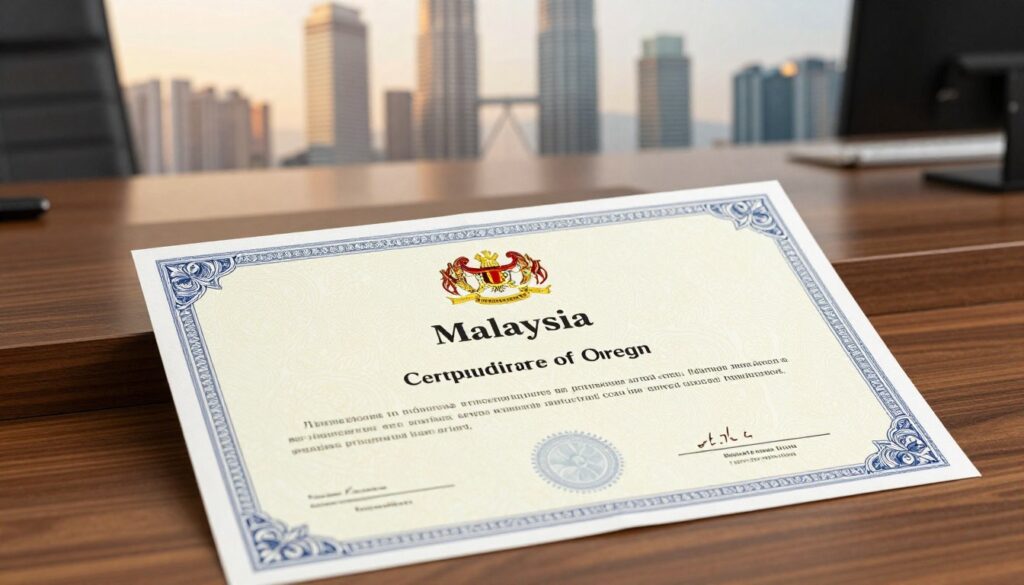
- To qualify for a certificate origin, products must meet specific content or transformation criteria.
- Exporters must show the product changed tariff code at six digits or met the minimum local value test.
- Eligibility for a preferential or a non-preferential certificate depends on the agreement that applies.
| Criterion | Requirement | Impact |
|---|---|---|
| Local content | ≥25% local input or 100% local manufacture | May qualify for preferential rates |
| Tariff change | HS code change at six-digit level | Meets rules origin in many agreements |
| Agreement type | Specific tests per free trade agreement | Determines certificate types issued |
Accurate documentation proves country origin and secures correct tariff treatment when rules align.
Getting Started with the ePCO System
Getting set up on ePCO begins with verifying your business identity and gathering manufacturing evidence. The ePCO system is the main online platform to apply for preferential certificate origin in Malaysia.
Registration Requirements for Manufacturers and Traders
To access the portal, register with DagangNet and submit certified true copies of your Certificate of Incorporation or Business Licence. This step proves your business is legitimate and unlocks the online application process.
Exporters must upload product details such as HS Code, process flow charts, and factory photos. The system captures all required information to support free trade agreement claims and the final certificate.
- Register at www.dagangnet.com to reach the ePCO portal.
- Submit certified company documents during registration.
- Provide clear product and production evidence in the form fields.
- Approved accounts receive a User ID and Password to use the service.
Using ePCO streamlines the origin application process and helps businesses manage documentation for international trade agreements.
Navigating the Cost Analysis Application
Begin your CA submission with verified invoices and a mapped production flow to speed approvals. This step must be completed with MITI before you file a PCO through the ePCO system.
What to include: confirm the HS code for your product, upload raw material invoices, and add a clear production flow chart. Provide concise information so reviewers can verify whether the goods meet the tariff reduction schedule under each agreement.
Timing matters. MITI aims to review cost analysis applications within five working days. Incomplete submissions are automatically rejected, so double-check every field before sending.
- The CA is a mandatory gate before requesting a certificate origin in the system.
- Accurate HS code confirmation prevents delays and misclassification.
- Complete documentation increases the chance of a quick approval and aligns your trade activities with the chosen agreement.
Managing Endorsements and Documentation
Clear, verified paperwork is essential to secure timely endorsements and smooth export clearance.
Start with a complete supporting set when you prepare an application. Common items include the completed form, commercial invoice, and a packing list. Chambers that issue non-preferential paperwork also require a Customs Export Declaration (Form K2) and a bill of lading to confirm movement between countries.
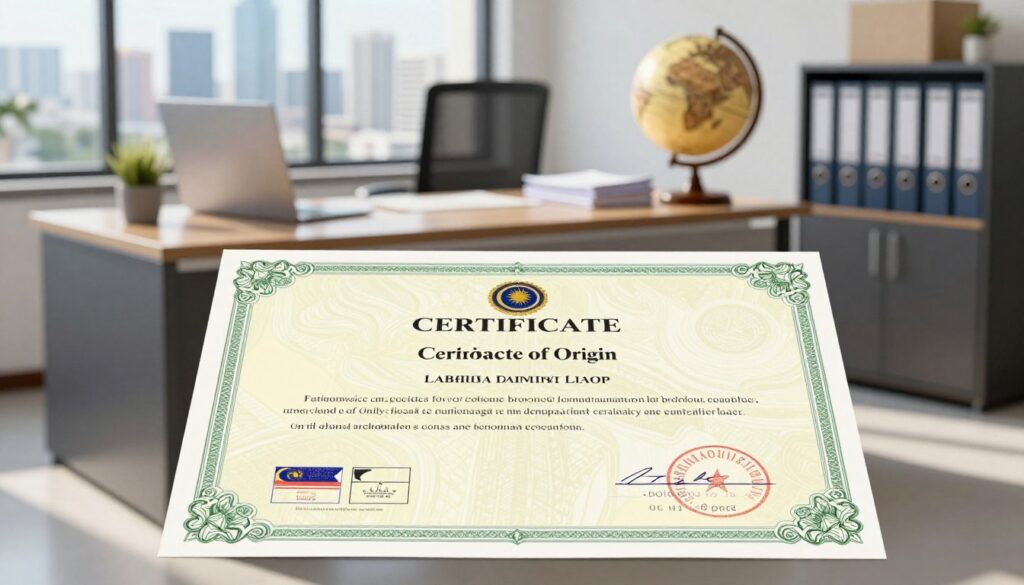
Required Supporting Documents
Each certifying authority checks that records meet the rules of the relevant free trade agreement. Keep originals and digital copies of invoices, packing lists, and any production evidence. MICCI endorsement of NPCO needs a full set: form, commercial invoice, packing list, and Form K2.
Submission Timelines
Submit complete packages to avoid automatic rejection. Review cycles move faster when entries are accurate and aligned to the required fields. Build an internal checklist so your application proceeds without gaps.
Electronic Signature Implementation
Since 15 January 2025, MITI adopted an electronic signature and official seal to endorse preferential certificates. This digital system reduces manual handling and speeds approvals across multiple countries and ports.
| Action | Required Documents | Impact |
|---|---|---|
| PCO endorsement (MITI) | Completed form, invoice, packing list | Electronic signature shortens approval time |
| NPCO endorsement (MICCI) | Form, commercial invoice, packing list, Form K2 | Ensures export movement verification |
| Final shipment filing | Bill of lading, export declaration, invoices | Helps clear customs and prove origin |
Keep an organized list of required documents and follow the digital process to avoid delays. A small routine check before submission saves time and supports smooth trade across countries.
Staying Updated on System Maintenance and Technical Disruptions
Planned system downtime and sudden outages can disrupt origin filing windows and shipment timing.
Between 31 October 2025 and 2 November 2025, the ePCO system underwent scheduled maintenance. During that period, all application processing was temporarily suspended. Users had to pause submissions and reschedule filing slots.
Technical issues at the ASW Gateway on 14 January 2026 and 3 February 2026 forced a short return to hardcopy form issuance. That step helped clear urgent export movements when the digital service was unavailable.
- Monitor official announcements before you submit any certificate origin or form.
- Keep backup hardcopy procedures ready to avoid delays in trade to other countries.
- Store key information and proof so an application can be refiled quickly after downtime.
| Date | Issue | Impact | Recommended Action |
|---|---|---|---|
| 31 Oct–2 Nov 2025 | Scheduled ePCO maintenance | Applications paused; delayed approvals | Plan submissions before maintenance; confirm timing |
| 14 Jan 2026 | ASW Gateway disruption | Temporary switch to hardcopy forms | Prepare printed forms and supporting records |
| 3 Feb 2026 | ASW technical outage | Short service interruption affecting trade | Monitor alerts and inform partners in affected countries |
Stay informed to protect the validity of certificates and to keep agreement-based benefits intact during unexpected downtime.
Best Practices for Maintaining Compliance
Keeping a tight checklist helps businesses meet stricter agreement rules that took effect last year.
Avoiding Common Documentation Errors
Verify each entry on the certificate origin and double-check HS codes before you submit an application to the system.
Match the invoice, packing list, and bill lading exactly to avoid mismatches that trigger delays or rejections by customs.
Since auto-approval ended on 11 August 2025, reviewers inspect filings more closely. Add photos, cost evidence, and clear product flowcharts to speed approval.
- Keep an ordered file of documents so the signature and date align with your submitted form.
- Follow the MY-UAE CEPA rules (effective 1 Oct 2025) to claim tariff treatment correctly.
- Consult a chamber commerce for help with non-preferential or preferential certificates and proof origin.
Small routines save time: a final checklist, matched documents, and clean signatures reduce returns and secure correct tariff treatment for your goods.
Conclusion
A short recap puts key actions in plain terms so teams can follow the proper filing routine.
Keep the certificate origin on hand when you submit an application through the ePCO system. Accurate invoice and packing list details speed review and help secure tariff benefits under trade agreements.
Centralized issuance by MITI has tightened checks and reduced misuse. Maintain clear production records, electronic signature proof, and a small internal checklist to avoid returns.
Stay alert to system updates and follow the rules in each agreement. These simple steps protect your shipments at customs and keep products moving with minimal delay.
FAQ
What is a certificate of origin and when do exporters need one?
A certificate that proves where goods were produced helps customs and tax authorities decide duties and trade treatment. Exporters typically need this document when shipping internationally, claiming preferential tariff rates under trade agreements, or complying with a buyer’s import rules. It also supports customs clearance and avoids delays at the port.
How do preferential and non-preferential documents differ?
A preferential document supports reduced or zero tariffs under free trade agreements like CPTPP or AANZFTA by proving specific origin rules. A non-preferential form simply states the country where the goods were made and is used for general trade, anti-dumping checks, or quota administration. Use the right type to get the correct tariff treatment.
What are the basic rules to qualify goods for preferential treatment?
Goods must meet product-specific rules of origin, such as wholly obtained status or sufficient regional value content, or a change in tariff classification. Manufacturers should document raw materials, production steps, and cost breakdowns to show compliance. Keep invoices, bill of lading, and packing lists to back up claims.
How do I register for the ePCO system and who must register?
Manufacturers, exporters, and authorized agents must register with the electronic portal that issues origin certificates. Registration requires business details, tax ID, contact information, and proof of manufacturing or trading activity. Chambers of commerce often guide applicants through verification steps.
What supporting documents are required when applying electronically?
Prepare commercial invoices, packing lists, bills of lading, production records, bills of materials, and cost sheets. For preferential claims, include supplier invoices and processing records to satisfy origin criteria. The chamber or issuing body may request originals or certified copies during verification.
How does the cost analysis application help prove origin?
The cost analysis shows how much local content or processing was added during manufacturing. It breaks down material, labor, overhead, and conversion costs to demonstrate regional value content thresholds or substantial transformation. Accurate accounting records and a clear methodology make approval smoother.
What are common documentation errors that cause rejections?
Frequent mistakes include incomplete invoices, mismatched product descriptions, missing signatures, incorrect HS codes, and failing to prove inputs or processing. Typos in business registration or inconsistent packing list details also trigger queries. Double-check entries before submission.
What are the submission timelines and validity periods?
Deadlines vary by issuing authority and destination rules. Many chambers allow applications before shipment or within a set window after export. Once issued, validity often ranges from a few months to a year depending on the agreement. Always confirm timelines with the issuing office and the importer.
Can electronic signatures be used on export documents?
Yes. Many issuing bodies now accept electronic signatures to speed processing and reduce paper use. Ensure the e-signature solution complies with local legal and chamber requirements and that signature authentication can be verified during audits.
How should exporters handle endorsements or amendments after issuance?
If details change after issuance, contact the issuing body immediately. Some chambers allow endorsements or reissuance with supporting evidence, while others require cancellation and a new application. Keep records of all communications and approvals for customs audits.
What should businesses do during system maintenance or technical outages?
Plan ahead by submitting applications early of peak periods. Keep offline copies of required documents and certificate templates. If the e-portal goes down, contact the chamber for emergency procedures or alternative submission methods to avoid shipment delays.
How can companies maintain ongoing compliance with origin rules?
Maintain organized records of purchases, production, and costs. Train staff on origin criteria and HS classification. Conduct periodic internal audits and consult trade experts or chamber advisors when implementing new production lines or sourcing changes. Proactive recordkeeping reduces risk in customs checks.
Which additional documents often accompany an application?
Typical attachments include commercial invoice, bill of lading, packing list, manufacturing declaration, supplier invoices, and product technical sheets. For some agreements, a declaration by the producer or importer may also be required. Always check the specific documentation list from your issuing authority.
How do trade agreements affect duty treatment and paperwork?
Each trade agreement sets rules that determine eligibility for reduced tariffs. Understanding the specific agreement—its product rules, required proofs, and authorized issuing bodies—helps exporters optimize duty savings and prepares them for customs queries at import.