
We open with a clear view of how a customs tariff shapes your trade decisions in Malaysia.
Classification is the first step. The WCO Harmonized System sets the first six digits used across 183 countries. Extra digits are country-specific and can change taxes and preferential rates.
We explain how the HS code, together with the value and currency of goods, determines duties and taxes payable. In the EU, export declarations usually use eight digits and import ones ten digits. TARIC links EU measures to national systems and helps automated clearance.
Our aim is practical: we show how accurate classification and clear rate assumptions cut risk. You will see how these parts affect landed cost, supplier talks, pricing, and margins in international trade.
Key Takeaways
- Getting the HS code right is foundational to predict duties and prices.
- WCO rules and national digits together determine rate outcomes.
- TARIC supports automated clearance but excludes VAT and excise.
- Accurate value and currency reporting changes duty calculations.
- We offer practical steps to reduce compliance risk and protect margins in Malaysia.
Understanding customs tariff in Malaysia today
Understanding how import duties affect your supply chain starts with clear rules and current rates.
Why these charges matter for import, export, and pricing decisions
A tariff is a duty imposed by a government or customs territory on imports and is paid by the importer. Export taxes are rare and paid by the exporter. Tariffs may be fixed, ad valorem, or variable.
For trade in Malaysia, these levies raise the landed cost that feeds into your wholesale and retail prices for specific products in a given country. That change affects whether you pass costs to customers, renegotiate with suppliers, or change assortments.
Present-day drivers: protection, revenue, and policy goals
Rates reflect three main goals: revenue collection, protecting domestic industry, and strategic industrial policy. Stay alert to new measures and updates in legislation that change competitive dynamics.
- Fixed duties: set per unit; predictable per-item cost.
- Ad valorem: percentage of value; rises with prices.
- Variable: linked to reference prices or bands; adds volatility.
| Impact | What you should do | Key benefit |
|---|---|---|
| Higher landed cost | Adjust markups and supplier terms | Protect margins |
| Policy shifts | Monitor measures and update quotes | Reduce contract risk |
| Rate type variability | Model scenarios by duty structure | Improve pricing accuracy |
We provide practical information so you align procurement, pricing, and compliance processes. Document classification and valuation to reduce disputes and keep offers viable when rates change.
What a tariff is and how it affects international trade
When a government imposes an entry tax on goods, it reshapes sourcing, pricing, and supplier talks.
Tariffs as import taxes and protection tools
A tariff is an import tax—often levied as a customs duty—collected at the border and added into landed cost. It raises the domestic price of foreign goods to reduce consumption and support local producers.
Fixed, ad valorem, and variable duties explained
Fixed duties charge a set amount per unit. Ad valorem duties are a percentage of invoice value.
Variable duties adjust with reference prices or bands, adding volatility to costs and margins.
Who ultimately pays and welfare effects
Importers usually remit the duty, but the economic burden often spreads to exporters and consumers through lower prices or higher retail prices.
Short-term protection can help industries, but economists agree higher taxes on imports tend to reduce welfare and slow growth over time. Retaliatory measures may also affect trade with other countries.
| Aspect | Business impact | Action |
|---|---|---|
| Fixed duty | Predictable per-unit cost | Model per-item margins and adjust markups |
| Ad valorem | Rises with invoice value | Negotiate FOB pricing and review declared value |
| Variable duty | Price volatility | Hedge costs and diversify suppliers |
HS code basics: the customs tariff number and classification
The HS number is the gateway that links your product description to the correct set of border rules.
The WCO core and the six-digit structure
The harmonized system is managed by the World Customs Organization and sets the six-digit HS core used in 183 countries.
These first six digits standardize how goods are described across foreign trade partners. That consistency reduces delays and supports predictable compliance.
Country extensions and preferential rates
Beyond six digits, countries add extra digits to reflect national needs. These extensions capture preferential rates, suspensions, quotas, and other taxation rules.
In the EU, for example, export declarations commonly use eight digits and imports use ten digits to map these local measures.
From description to code: practical steps
Materials, function, and intended use determine the right code. Accurate descriptions protect margins by preventing under- or over-payment of duties.
| Element | Why it matters | Practical tip |
|---|---|---|
| Six-digit HS core | Global harmonisation across countries | Start classification here |
| Additional digits | National measures and preferential rates | Check local nomenclature |
| Product description | Determines final number and duties | Document materials, function, and use |
We recommend clear documentation and review of explanatory notes and chapter rules. This helps your team defend the chosen code if queried by a border authority.
How to determine the correct HS/customs code for your goods
Start with a technical file for every item: list materials, composition, function, end-use, and key dimensions. This step makes classification clear and repeatable.

- Use the General Rules of Interpretation and section or chapter notes to guide choices.
- Consult official nomenclature and national databases from the world customs organization and your customs organization to validate codes.
- Request advance rulings when legislation is unclear and compile evidence—samples, datasheets, and test reports—to support your case.
| Step | What to record | Why it matters |
|---|---|---|
| Technical file | Materials, function, dimensions | Defines essential character for classification |
| Interpretation | Apply rules and notes | Avoids misclassification and rework |
| Validation | Official databases and rulings | Reduces disputes at the border |
We also advise controls to track version changes and store classification data for audits. A proactive workflow cuts delays, lowers costs, and keeps your trade operations predictable.
Types of customs duties and rates you’ll encounter
Duty formats and special measures determine the extra layers added to an import invoice.
Ad valorem, specific and compound structures
Ad valorem is charged as a percentage of value. It rises with invoice price and can affect margins as prices move.
Specific charges are fixed per unit and give predictability when volumes are stable. Compound rates combine both and need careful modelling.
Trade defence and additional measures
Antidumping, countervailing and safeguard measures add extra levies and temporary restrictions. These instruments often stack on top of normal duties and create sudden cost increases for trade in affected goods.
Quotas, suspensions and preferences
Tariff quotas and autonomous suspensions open windows of reduced charges. Preferences cut taxes when origin criteria are met. Monitor availability and document origin to claim relief.
| Type | Business impact | Action |
|---|---|---|
| Ad valorem | Costs follow invoice | Negotiate price elements and declared value |
| Specific | Predictable per-unit cost | Model by SKU and volume |
| Trade defence | Extra levies & restrictions | Track measures by HS and country |
We recommend alerts for quota thresholds, regular checks of rate tables, and clear notes in contracts so you can reissue quotes when rates or measures change.
Inside the EU’s TARIC: a model for integrated tariff measures
TARIC combines legal measures and product codes into a single reference that all EU authorities use. It is a practical model for any trader who needs one clear view of applicable rules across the european union.
What TARIC contains
The system unifies the goods nomenclature, additional codes and supplementary units. It also records EU document codes (Data Element 2/3) and country/territory identifiers.
Prohibitions, restrictions and product control
TARIC links prohibitions and restrictions to each goods number. This includes trade defence, quotas, and controls for CITES, dual-use, F-gases, and sanitary checks.
Daily data flow and automation
Daily electronic transmissions feed national systems so declarations can clear automatically when criteria match. This reduces manual checks and speeds trade processing.
- One database view: uniform measures across Member States for planning and statistics.
- Practical outputs: raw data in Excel and a legal basis under Council Regulation (EEC) No 2658/87.
- What is excluded: VAT and excise rates are not part of TARIC and must be sourced from national systems.
We recommend studying TARIC’s structure to inform Malaysian systems and to improve your internal compliance and reporting dashboards.
Applying global frameworks to Malaysia’s import export workflows
A reliable workflow ties HS identification to value reporting and currency conversion before goods move.
Bridging HS fundamentals with national legislation and systems
We map the six-digit HS core to Malaysia’s extensions and legal codes. This ensures you record the right number for every SKU.
Clear mapping reduces classification disputes and speeds clearance. It also helps teams prepare compliant paperwork for imports and audits.
From code to calculation: value, currency, and duty payable
We connect declared value and the applicable currency rate to the HS entry. That link produces an auditable landed cost before you place an order.
Practical controls include SOPs for currency rates (spot, official, or reference) and a single data model that ties code, value, and measures.
- Align HS codes with national tables and monitor changes across countries you source from.
- Use a structured system and dashboards to flag high-impact code changes.
- Maintain governance to keep classification and calculation aligned with current legislation.
| Element | Action | Benefit |
|---|---|---|
| HS code mapping | Map six-digit core to national extensions | Accurate duty estimates |
| Value & currency | Apply declared value with chosen exchange rate | Auditable landed cost |
| System controls | Dashboards and SOPs | Faster clearance and fewer errors |
Step-by-step: calculating your landed cost with tariff rates
Start by building a clear worksheet that ties product price, transport, and insurance into one auditable value. This single view prevents errors and speeds decision-making for trade teams in Malaysia.
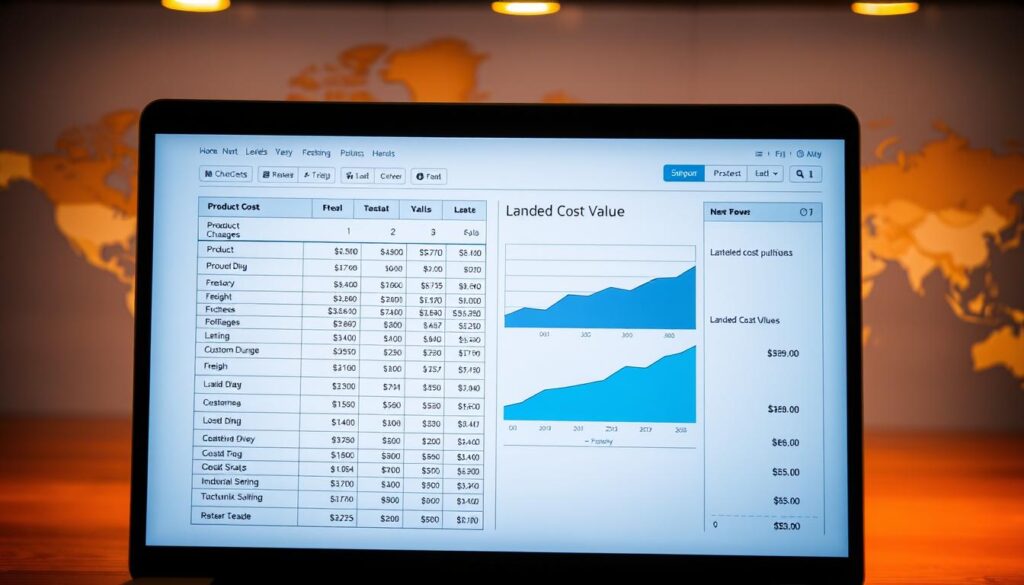
Determining customs value and currency conversion
Construct customs value from: product invoice, freight, insurance, and other includable charges. Record Incoterms and documentary evidence for each element.
Timestamp exchange rates and choose the official or central bank rate that applies. This keeps the declared value consistent and audit-ready.
Adding duties, taxes, and other measures to get total cost
Use the HS code to pick the correct rate structure—ad valorem, specific, or compound—and apply it to the declared value or unit basis as required.
Layer in other taxes and levies, noting which elements are calculated on the declared value to avoid double counting. Include any antidumping or additional measures attached to the code in your worksheet.
“An auditable landed cost ties valuation, exchange rates, and measure data so prices and margins remain reliable.”
- Link HS code, rate, and valuation fields so prices flow into your ERP.
- Maintain controls over exchange rates, versioning, and approvals.
- Reconcile estimated versus actual costs after clearance to refine forecasts.
| Step | Action | Outcome |
|---|---|---|
| Valuation | Record invoice, freight, insurance, Incoterm | Single auditable value for calculation |
| Conversion | Apply stamped official currency rate | Consistent declared value across entries |
| Rate application | Apply ad valorem/specific/compound by code | Accurate duty and taxes on imports |
| Governance | Version control, approvals, data checks | Reliable landed cost for pricing and margins |
We recommend a short reconciliation loop after clearance so you can update future quotes and protect prices and margins in ongoing trade.
Compliance essentials: documents, codes, and controls at the border
Border control hinges on precise product data, valid certificates, and aligned broker instructions. We focus on the practical checks you must run before shipment to avoid holds and penalties.
Data elements: product codes, country/territory codes, and additional references
Record accuracy matters. Maintain product classification codes and the correct country and territory codes for every line item.
Include documentary references such as invoice numbers, licence IDs, and TARIC-style document codes (Data Element 2/3) so entries match uploaded files. This reduces manual queries and speeds automated clearance.
Certificates, licenses, and sanitary/phytosanitary requirements
Identify certificate triggers by HS code early. For food and agricultural products, ensure veterinary and phytosanitary certificates are valid and linked to the shipment.
Keep expiry dates current and store scanned proofs in the same record as the product code to avoid last-minute gaps at the point of entry.
Dual-use, CITES, and restricted goods considerations
Screen items for dual-use status and CITES listings during product intake. These restrictions change transit timelines and may need licences.
Design control points to validate documents before you tender shipments, align broker instructions with your codes, and train frontline teams to escalate suspect goods early.
- Manage integrated measures data so documentary needs are clear at booking.
- Create a checklist that ties certificates to shipment records and product codes.
- Implement a short audit trail for approvals to reduce risks on imports.
“A clear document pipeline and disciplined controls prevent delays and protect margins.”
Pricing strategy and supply chain impact of tariff changes
When border measures change, your procurement and pricing plans must adapt quickly to protect margins. We show a clear framework to convert measure shifts into commercial action.
Managing input cost volatility and retaliatory measures
Higher levies on imports raise prices of intermediate goods and finished products. We recommend threshold rules that tell you when to pass costs to customers, absorb them, or renegotiate with suppliers.
Link changes in duty or taxes to margin targets so decisions are repeatable and auditable.
Scenario planning for sourcing and market entry
Build three scenarios—baseline, stress, and shock—covering possible retaliatory measures and changes by country.
- Stress-test BOMs for duty sensitivity and set triggers for supplier switches or SKU rationalisation.
- Protect key accounts by pre-notifying likely price moves and offering lower-cost alternatives.
- Embed price adjustment and reopener clauses in contracts to manage long-term risk.
“Dashboards that track prices, taxes and measures by country give weekly signals to protect contribution margins.”
We also recommend governance around approvals for price changes so your responses stay consistent across markets.
Data sources and tools to research tariff measures and statistics
Daily-fed databases give you the live signals needed to manage duties, quotas and controls.
We rely on authoritative portals for classification and measure lookup. The World Customs Organization provides the six-digit HS core and official nomenclature. National nomenclature portals and the WCO site are the primary starting points for reliable reference and access.
Using integrated tariff databases
The european union’s TARIC is a practical model. It is multilingual, transmits measures daily to national systems, and offers raw data in Excel. TARIC contains goods nomenclature, additional codes, EU document codes and country identifiers. Note: it excludes VAT and excise. The legal basis is Council Regulation (EEC) No 2658/87.
- Extract raw files to create benchmark analytics and statistics.
- Combine HS number intelligence with document and territory codes for lookups.
- Integrate daily data streams into your master data system and view layers.
“Daily, authoritative feeds let teams act before a change hits the supply chain.”
| Source | What it contains | Practical use |
|---|---|---|
| WCO resources | HS nomenclature and explanatory notes | Standard classification and global alignment |
| TARIC/raw files | Measures, codes, supplementary units | Benchmarking and extraction for analytics |
| National portals | Local extensions and operational rules | Apply rates and document triggers for trade |
Best practice: manage access rights, enforce version control, and map measures to business impacts like taxes, quotas and controls. Build dashboards to flag food and other sensitive categories. Use the EU example as a benchmark, then adapt workflows to Malaysia’s regulatory environment.
Common mistakes in customs classification and how to avoid them
Many disputes begin with a rushed code choice and incomplete product details.
The HS number is driven by product description: the first six digits are harmonised worldwide, while extra digits vary by country. Missing or wrong details lead to incorrect customs tariff outcomes and unexpected taxation at the border.
- Selecting a number by price rather than product information. This causes near-miss codes and wrong duties.
- Ignoring section and chapter notes or misreading digits beyond six. National extensions in other countries change outcomes.
- Failing to build robust product files. Document materials, function, and intended use so the chosen code is defendable.
- Not using dual review for sensitive items and lacking a written rationale to present to authorities.
We recommend periodic audits of imports to confirm the declared code matches shipped goods. Create a feedback loop between compliance and procurement so classification issues are caught before purchase orders are issued.
“Documented choices and routine audits reduce overpayment, underpayment and audit exposure.”
customs tariff, action checklist for Malaysian traders
A practical action checklist turns classification and rate data into repeatable controls you can use before every shipment.
TARIC shows how integrated measures, document codes, and controls speed clearance while excluding VAT and excise. The six-digit HS core gives global consistency, and country-specific digits change final rates across countries.
Before you import or export, follow a short set of checks. These steps reduce delays and protect margins in trade.
- Confirm HS classification by reviewing section and chapter notes and gain access to official nomenclature resources before any import.
- Verify national digits and applicable measures, then record the duty rate and conditions in your internal checklist.
- Validate control requirements early—licenses, SPS certificates, and other permits—so shipments meet your goal and avoid holds.
- Align documentation with current legislation and ensure broker instructions match declared codes and conditions.
- Simulate landed cost scenarios for import and export routes and test alternative suppliers or countries when measures tighten.
- Set approval thresholds for price changes driven by duty shifts and monitor imports with high exposure.
- Maintain a central repository for classification decisions, rulings, and updates with controlled access for your teams.
- Perform quarterly reviews to confirm exposure remains accurate and under control.
| Action | What to record | Key benefit |
|---|---|---|
| Classification check | HS code, notes, national digits | Accurate rates and fewer disputes |
| Document & licence validation | Permits, SPS, broker instructions | Faster clearance and fewer holds |
| Cost simulation | Landed cost scenarios, supplier options | Resilient pricing and controlled margins |
“A short, enforced checklist turns complex rules into operational certainty.”
Conclusion
A systems approach brings classification, valuation and measures into one auditable workflow.
We reinforce that a customs tariff is an import duty paid by importers and may be fixed, ad valorem, or variable. The HS code’s first six digits are harmonised globally; extra digits by country determine final duties and taxes.
You can now translate rate structures into pricing and sourcing choices across countries and routes. Link value and currency fields to classification so landed cost is defensible before you commit capital.
Use integrated databases for a unified view of measures while sourcing VAT and excise separately. Monitor restrictions, embed governance, and keep teams aligned as imports grow.
We stand ready to help you operationalize these steps and keep your trade operations resilient and profitable.
FAQ
What is a customs tariff and why does it matter for my import or export business?
A customs tariff is a government charge applied to goods crossing a border. It affects your landed cost, pricing, and competitiveness. For Malaysian traders, duties influence sourcing decisions, profit margins, and compliance requirements. Understanding duty types and rates helps you forecast costs and avoid unexpected taxes or penalties.
How do different duty types—ad valorem, specific, and compound—affect cost calculations?
Ad valorem duties are percentage-based on the declared value. Specific duties use a fixed amount per unit or weight. Compound duties combine both. Each changes your landed cost differently: ad valorem scales with price, specific can favor higher-value items, and compound increases complexity in valuation and accounting.
What role does the Harmonized System (HS) code play in determining duties?
The HS code classifies your product and is the primary determinant of applicable duties, taxes, and trade measures. The World Customs Organization’s first six digits are standard internationally; countries add digits for local detail and preferential rate eligibility. Accurate coding prevents misclassification penalties and wrong duty payments.
How can we determine the correct HS/customs code for our goods?
Gather full product details—materials, function, and intended use—then apply the Harmonized System’s General Rules of Interpretation and chapter notes. Validate your choice using national tariff databases or formal binding rulings from customs authorities to reduce reclassification risk.
Who ultimately bears the cost of import duties: the importer, exporter, or consumer?
Importers usually pay duties at the border, but costs are often passed downstream to buyers. Market structure, contract terms, and pricing strategy determine who ultimately absorbs the charge. We recommend scenario analysis to decide how to allocate or mitigate these costs.
What non-tariff measures should Malaysian importers watch for?
Watch for sanitary and phytosanitary rules, licenses, quotas, dual-use controls, and CITES restrictions. These measures can block entry or require additional documentation and testing. Early identification of controls avoids shipment delays and compliance costs.
How do trade defence measures like anti-dumping and safeguards affect duties?
Trade defence measures can impose additional duties or provisional levies on targeted products to counter unfair pricing or surges in imports. Such measures raise import costs suddenly and may require you to adapt sourcing or pricing strategies quickly.
Where can we find reliable tariff data and national measures for Malaysia?
Use the World Customs Organization for HS guidance, Malaysia’s Royal Malaysian Customs Department for national rates and rulings, and integrated tariff databases like TARIC for EU benchmarking. Official databases and published notices provide binding information and updates.
How do tariff quotas and preferential regimes impact duty rates?
Tariff quotas allow limited quantities at reduced or zero duty until the quota fills. Preferential regimes—such as free trade agreements—grant lower rates if origin criteria are met. Proper documentation and origin proofs are essential to claim benefits and avoid penalties.
What steps should we take to calculate landed cost including duties and taxes?
Determine customs value and convert currency, then apply the relevant duty rate and add taxes (e.g., VAT) and other charges like excise or anti-dumping duties. Include freight, insurance, and handling to reach total landed cost. Accurate calculation supports pricing and margin decisions.
How do EU systems like TARIC differ from Malaysia’s tariff framework?
TARIC integrates tariff classifications with additional measures and supplementary codes for the EU. It focuses on harmonized nomenclature, prohibitions, and automated data exchange. Malaysia’s system follows the HS core but uses country-specific extensions, legislation, and administrative procedures.
What common classification mistakes lead to penalties or higher duties?
Errors include incomplete product descriptions, ignoring chapter notes, using generic codes, and failing to secure binding rulings. Misvaluation and incorrect origin claims also trigger audits. Proper documentation and expert classification reduce errors and enforcement risk.
How should we prepare for tariff changes that affect supply chains?
Implement scenario planning: assess exposure by product and supplier, model cost impacts, and identify alternative sourcing or product adjustments. Maintain flexible contracts and inventory buffers to manage short-term volatility and retaliatory measures.
What documentation is essential at the border to clear shipments smoothly?
Key documents include commercial invoices with complete product details, packing lists, certificates of origin, licenses, and sanitary or phytosanitary certificates where required. Ensure accurate HS codes and currency declarations to avoid delays and fines.
Can we validate a tariff classification before shipping?
Yes. Request a binding ruling from the Royal Malaysian Customs Department or use official tariff tools and advisory services. A binding decision provides certainty on duty treatment and protects against retrospective reclassification.
How do value, currency exchange, and invoice adjustments influence duty assessments?
Customs duties often apply to the declared transaction value, which fluctuates with currency shifts and invoice adjustments like discounts or commissions. Ensure correct valuation methods and consistent currency reporting to prevent disputes and recalculations.
What is the best approach to managing compliance and avoiding inspections?
Maintain accurate product data, standardized coding procedures, and up-to-date documentation. Invest in staff training, use validated databases, and seek professional audit support. Proactive compliance reduces inspection risk and accelerates clearance.
How do preferential tariffs under FTAs get applied in practice?
To claim preferential rates, you must meet origin rules, provide a certificate of origin or supplier declaration, and follow procedural requirements. Customs will verify origin during clearance or audits; failing proof leads to standard duty application and penalties.
Where can we get professional help for complex tariff or classification issues in Malaysia?
Engage licensed customs brokers, trade lawyers, or consultancy firms familiar with Malaysian legislation and WCO guidance. We provide tailored advisory services to classify goods, secure rulings, and optimize duty exposure while ensuring compliance.