
Every employer must handle statutory payroll deductions accurately. In this guide, we explain how mandatory contributions protect employees and what employers need to do each month to stay compliant. These deductions affect wages, payment schedules, and retirement planning for workers across the country.
Getting deductions right avoids heavy fines and legal trouble. The Employment Act 1955 makes these payments a legal duty, and missed deadlines or wrong calculations can trigger audits or penalties. This short intro prepares you for clear steps ahead.
We will cover contribution rates, the calculation methods, critical deadlines, and the employer portal you’ll use for payments. Read on to learn simple, practical tips to keep payroll accurate and your team protected.
Key Takeaways
- Mandatory deductions are legal obligations that protect employees and their retirement.
- Employers must track rates, deadlines, and payment schedules every month.
- Accurate calculation of contributions prevents fines and audit notices.
- Use the official portal to submit payments and maintain records.
- Staying updated on rules helps maintain good worker relations and compliance.
Understanding Statutory Payroll Deductions in Malaysia
Understanding statutory payroll deductions helps employers manage costs and keeps employees protected. These deductions fund retirement, social protection, and tax services for workers.
Employers are legally required to deduct set percentages from an employee’s gross salary and remit the payments each month. The framework includes the Monthly Tax Deduction (MTD) and three core funds: epf, socso, and eis. Each system runs under its own law, such as the Income Tax Act 1967.
“Accurate records and timely remittance prevent fines and protect the employer-employee relationship.”
Keep precise records of all deductions and contributions. This helps your company avoid audits and unexpected liabilities. Staying informed on rule changes is a practical tip for HR managers and business owners.
- Why it matters: Protects workers and reduces employer risk.
- What to track: rates, schedule, payment amount, and portal submissions.
- Good practice: review calculations, keep digital records, and update payroll each year.
| System | Who Pays | Typical Rate | Payment Period |
|---|---|---|---|
| Retirement Fund | Employer & employee | Varies by age | Monthly |
| Social Protection | Employer & employee | Fixed contribution | Monthly |
| Employment Insurance | Employer & employee | Small fixed share | Monthly |
The Role of EPF SOCSO EIS Malaysia in Employee Benefits
Mandatory workplace funds play distinct roles in securing long-term income and guarding against accidents and unemployment.
Retirement savings are governed by the EPF Act 1991, which requires both employer and employee contribution to a provident fund. These epf contributions build a retirement nest egg over the years and help workers plan for old age.
Retirement Savings
Regular monthly contribution and accurate calculation of each payment ensure the correct amount reaches an employee’s account. Employers must track rates by age and update payroll schedules each year.
Social Protection
SOCSO provides the Employment Injury Scheme and the Invalidity Scheme to support employees after workplace accidents or permanent disability. The EIS adds income replacement and upskilling for those who lose work.
- Employee registration: employers must register eligible employees and remit contributions on schedule.
- Value to staff: clear communication of benefits improves retention and trust.
“These three pillars keep workers protected, stable, and ready to return to work.”
Mastering EPF Contribution Rates and Calculation Requirements
Mastering the numbers behind statutory contributions prevents backpay and compliance headaches. This short guide shows the key thresholds, rounding rules, and options for extra saving.
Employer contribution thresholds
Use the Third Schedule of the EPF Act 1991 to calculate mandatory contributions for wages up to RM20,000. For employees earning RM5,000 or less, the employer rate is 13%.
For salaries above RM5,000 the employer rate becomes 12%. Apply these rates each month to the employee’s basic salary and report the correct amounts.
Rounding requirements
Sum all employee and employer contributions first, then round the total to the nearest ringgit. Rounding mistakes often trigger audits. Avoid per-line rounding which compounds errors over time.
Voluntary contributions
Employers and employees may make voluntary contributions to boost retirement savings. Note that overtime payments are generally excluded from the calculation, but double-check each pay component.
- Register new employees within 7 days of start date to comply with registration rules.
- Late payment of contributions attracts interest based on the dividend rate plus 1% p.a., minimum RM10.
“Accurate calculation each month protects workers and reduces employer exposure.”
Navigating SOCSO Coverage and Contribution Categories
Knowing how contribution brackets work keeps payroll accurate and employees protected. The wage ceiling rose to RM6,000 in October 2024, so calculate contributions up to that amount when you run monthly payroll.
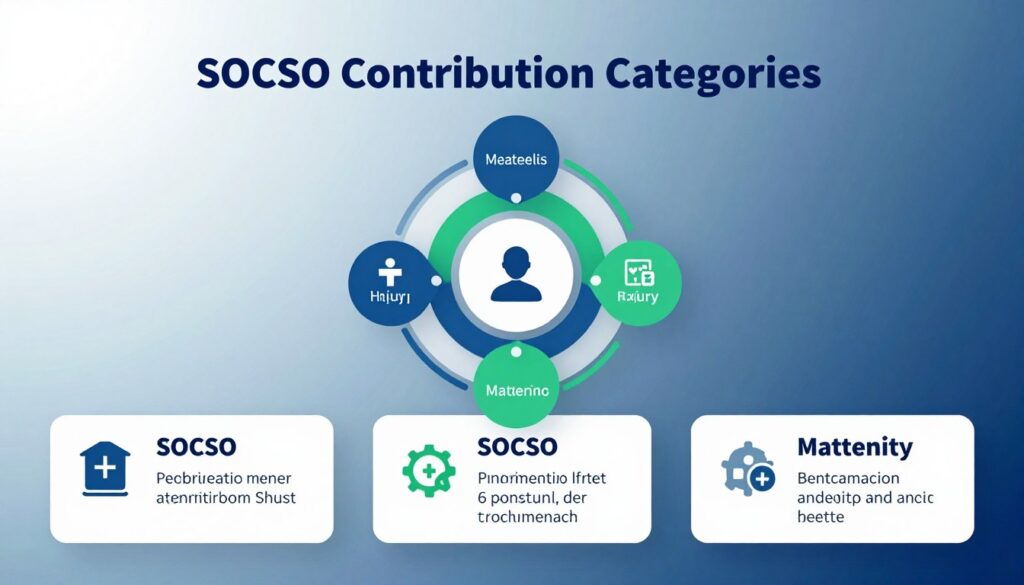
All private-sector workers must be covered under the social security scheme. Employers should register with PERKESO within 30 days of hiring their first staff to avoid penalties.
Contribution categories use fixed wage brackets. Use the official Rate of Contribution tables from PERKESO and pick the correct category for each employee. Employees aged 60+ remain under the Employment Injury Scheme but do not pay Invalidity Scheme contributions.
Late payment carries a 6% annual interest, charged daily until the amount clears. Keep accurate monthly records and report workplace injuries within 48 hours via the PERKESO ASSIST portal. The portal also accepts payments through FPX and helps register foreign workers covered since January 2019.
“Applying the right category for each worker avoids compliance issues and protects your team.”
Employment Insurance System Requirements for Employers
A practical employer checklist helps you apply the right deduction each month and keep staff protected. The total contribution equals 0.4% of the employee’s monthly salary, split 0.2% from the employer and 0.2% from the employee.
Coverage generally spans workers aged 18 to 60 who are employed under a contract of service in the private sector. Proper registration with the social security body automatically enrolls eligible employees for this scheme.
Eligibility and employer duties
Domestic servants, civil servants, and self-employed persons are exempt from this contribution under current rules. Employers must still check each employee’s status and apply the correct deduction.
Benefits require meeting qualifying contribution conditions and filing a claim within 60 days of job loss. Late payment of contributions triggers the same penalty structure as the social security scheme, with interest charged at 6% per annum on outstanding amounts.
- Employer action: register staff, deduct 0.2%, and remit combined 0.4% monthly.
- Keep records: track payments and calculation method each month to avoid audits.
- Support: the system funds job search services and training to speed re-employment.
Essential Deadlines for Monthly Statutory Payments
Treat the 15th as the payroll anchor: all statutory contributions must be paid to the relevant agencies by the 15th of the following month.
If the 15th falls on a weekend or public holiday, the deadline moves to the preceding working day. This rule prevents late payment penalties and keeps employee benefits active.
Timely remittance matters. Missing the deadline can trigger interest charges that compound daily for social security and employment insurance contributions. For the retirement fund, late payment can even mean criminal penalties, including fines or imprisonment.
- Employers must strictly adhere to the 15th to avoid late payment charges.
- Keep a shared calendar of payroll cut-offs so HR and finance align each month.
- Automate schedules in payroll software to ensure the correct contribution amount is calculated and remitted ahead of the due date.
- Consistent compliance protects employees’ benefits and shields the employer from audits.
“Prioritizing the deadline keeps benefits uninterrupted and the business safe from mounting penalties.”
Monthly Tax Deduction Computation Methods
Correct monthly tax computation protects both staff and employers from penalties and sudden liabilities.
PCB (Potongan Cukai Bulanan) is the system that spreads an employee’s income tax across the year. Employers calculate a monthly deduction based on remuneration, marital status, and dependents.
Understanding PCB Computation
Employers must use the official LHDN PCB tables or an approved payroll system to find the right amount. Manual guesses can lead to errors and a 10% penalty on unpaid sums if the payment is late.
Remit PCB payments to LHDN by the 15th of the following month. Timely payment avoids a 10% penalty and reduces the risk of prosecution under the Income Tax Act 1967.
Tax Relief Forms
Employees submit TP1 or TP3 to claim reliefs. These forms change the monthly deduction and lower the amount taken from salary.
Employers must collect completed forms, apply the correct rate, and report via MyTax or the employer portal each month. Accurate processing helps employees avoid large tax bills at year-end.
| Item | Who Inputs | Effect on PCB | Deadline |
|---|---|---|---|
| Remuneration & wage details | Employer | Directly determines deduction | Monthly (by 15th) |
| Marital status & dependents | Employee (TP1/TP3) | Reduces monthly PCB | Before payroll run |
| Payroll system calculation | Employer/Payroll provider | Ensures table-based accuracy | Each payroll cycle |
| Payment submission (MyTax) | Employer | Covers legal remittance | 15th of following month |
“Accurate PCB management is a legal duty that keeps employees compliant and employers protected.”
Managing EA Form Reporting and Submission Deadlines
Preparing EA Forms on time is a key employer duty. The EA Form is the annual income statement that shows remuneration, epf, PCB and other deductions for each employee.
Employers must ensure every employee receives their EA Form by February 28 so staff can meet the April 30 tax filing date.
The employer must also submit all EA forms to LHDN by March 31 to complete the annual reporting cycle.
- What the form shows: yearly salary, wages, benefits-in-kind, and contributions taken each month.
- Use e-Filing (C.P.8D): submitting digitally speeds processing and reduces errors.
- Penalties: late submission can cost RM200 to RM20,000 per form.
Accurate reporting of benefits-in-kind matters. Underreporting creates tax assessments and legal exposure for the employer and employee.
“Providing EA Forms on time is a simple step that supports employees and keeps payroll teams compliant.”
Handling Foreign Worker Statutory Compliance
Starting October 2025, payroll teams must apply a simplified contribution rate for foreign hires. This change affects monthly payroll runs and requires quick updates to systems and records.
New Mandatory Requirements
Both employer and employee will pay a flat 2% contribution to the retirement fund for foreign staff. Employers must also ensure foreign employees are registered under the social protection scheme so contributions and injury cover apply.
Domestic servants are generally exempt, but verify each household staff member’s employment status before adjusting payroll. Proper documentation of work permits prevents errors in the amount you remit and reduces audit risk.
- Update payroll software to calculate the new 2% rate automatically each month.
- Register valid work-permit holders as members of the funds and confirm wage records.
- Non-compliance can trigger backpay, interest, and penalties for the employer.
| Worker Type | Employer Obligation | Typical Rate |
|---|---|---|
| Foreign employee with permit | Register and remit monthly | Employer 2%, Employee 2% |
| Domestic servant | Verify exemption status | Generally exempt |
| Local worker (for contrast) | Follow tiered rates by age | Varies by salary and age |
Staying current on these rules helps employers manage foreign staff and avoid costly compliance gaps.
Common Payroll Errors and How to Avoid Them
Simple classification errors in payroll often lead to costly audits and employee disputes. Mislabeling overtime payments as regular salary, or using the wrong rate table, creates incorrect contribution totals and confused employees.
Watch the Third Schedule closely. Incorrect application of the third schedule or failure to update for a new wage ceiling causes wrong EPF deductions under the epf act 1991 and triggers backpay issues.
Other frequent mistakes include rounding each portion separately and missing new-hire registration deadlines. Late payment of monthly statutory amounts compounds interest and can start legal action against an employer.
- Use validation rules in payroll software to flag unusual rates or missing registrations.
- Audit payroll records monthly to catch misclassifications and calculation slips early.
- Document each employee’s wage components clearly so overtime payments are treated correctly.
“Consistent checks and reliable systems reduce errors and protect both employer and employee.”
Leveraging Professional Payroll Systems for Compliance
A reliable payroll platform reduces manual checks and keeps statutory calculations error-free. Modern systems apply the correct contribution rates from the third schedule and the epf act automatically.
Built-in validation ensures rounding follows the rules in act 1991 and prevents per-line rounding mistakes that cause discrepancies.
Automated deadline tracking reminds employers of monthly payment dates and cuts the risk of late fees. Year-round data compilation also speeds EA form generation and simplifies annual reporting.
Real-time updates handle changes to wage ceilings and new mandatory rules, so employers don’t need manual tweaks.
“Centralized payroll data creates a single source of truth for audits and makes reporting straightforward.”
- Validation: checks contribution amounts and wage inputs.
- Automation: applies statutory rates and deadline alerts each month.
- Reporting: gives robust exportable summaries for audits and planning.
| Feature | Benefit | Why it matters |
|---|---|---|
| Automatic rate updates | Always use current contribution rates | Reduces manual errors and backpay risk |
| Rounding validation | Ensures correct total amounts | Prevents audit triggers from small calculation faults |
| Deadline alerts & reports | On-time monthly payments | Minimizes interest charges and penalties |
Choosing Between Software and Outsourcing Services
Deciding whether to run payroll in-house or hire specialists affects accuracy, cost, and control. Your choice will shape how payroll tasks, statutory submissions, and agency queries are handled each month.

Benefits of HR Software
HR software offers businesses greater control over payroll processes while automating calculations and deadlines. Good systems validate rates, round totals correctly, and store payment records.
This helps keep contributions accurate and reduces manual work for HR and finance.
Outsourcing Advantages
Outsourcing suits companies that want a hands-off approach. Compliance specialists manage statutory submissions and answer queries from agencies on behalf of the employer.
- Fully managed filings and documentation.
- Peace of mind for complex wage or foreign worker rules.
- Option to combine software for monthly runs and experts for year-end reporting.
“The right setup ensures timely, accurate payments and protects your business from mistakes.”
Choose based on size, budget, and payroll complexity. The goal is simple: accurate contributions, on-time payments, and fewer compliance headaches for employers and employees.
Conclusion
Finish strong by turning monthly payroll tasks into repeatable habits that prevent costly mistakes. ,
Mastering statutory compliance protects your business from fines and keeps staff benefits secure. Review contribution rules for epf, socso, and eis so each pay run is correct.
Keep the 15th and February 28 in your calendar. These deadlines ensure timely remittance and clean records.
Choose the tool that fits your team: reliable payroll software or a trusted outsourcing partner. Accuracy and consistency matter most.
Review processes now for 2026. Small, proactive fixes save time, reduce audit risk, and build a more secure workplace.
FAQ
What does the deduction on my payslip cover?
Deductions typically fund retirement savings, workplace injury protection, and short-term employment insurance. Employers and employees both contribute based on salary bands and statutory rates set under national acts. These deductions appear monthly and support benefits like pensions, medical coverage for work injuries, and temporary income support for job loss.
Who must register and remit monthly statutory payroll contributions?
All employers with salaried staff must register with the relevant agencies and remit contributions monthly. This includes private companies, sole proprietors, and non-citizen employers for foreign staff. Payments are due by specific deadlines each month to avoid penalties and interest for late payment.
How are contribution amounts calculated for each employee?
Contributions are based on the employee’s wages, which include salary, basic allowances, and selected cash payments. Each scheme uses its own percentage rates and salary caps. Employers must apply the correct rate to the relevant wage base and follow rounding and threshold rules when computing amounts.
Are overtime payments included when calculating contributions?
Yes, most overtime and variable pay items count toward the wage base for contribution calculation unless explicitly excluded by regulation. Employers should review guidance on what constitutes pensionable or insurable earnings to ensure accurate reporting.
What are the employer and employee contribution rates and when do they apply?
Rates vary by age group and by scheme. Employers must apply the mandated employer share and deduct the employee share from wages each pay period. Contribution schedules and any recent rate changes should be confirmed through official notices to ensure compliance.
Can domestic helpers and casual workers be excluded from these contributions?
Domestic helpers and casual workers may be covered depending on their employment status and number of hours. Employers should classify workers correctly and register them where required. Misclassification can lead to back payments, penalties, and legal exposure.
What happens if an employer makes late payments?
Late remittances typically incur interest and penalties. Repeated noncompliance can prompt inspections or enforcement actions. Employers should use the official portal or approved channels for timely payment and retain proof of submission.
Are voluntary contributions allowed and how do they work?
Employees and employers can often make voluntary top-ups to boost retirement savings. Voluntary payments follow specific procedures and limits; employers must record these correctly and ensure they do not violate contribution caps or tax rules.
How should payroll systems handle rounding and thresholds?
Payroll systems must implement the statutory rounding rules and minimum thresholds when computing contributions. Accurate software settings prevent small calculation errors that accumulate into compliance issues. Regular audits of system logic are recommended.
What documentation must employers provide employees annually?
Employers must provide annual income statements that detail wages and contributions withheld. These forms support individual tax filing and benefit claims. Timely distribution helps employees verify records and avoid disputes.
How does coverage change for employees who reach retirement age?
Contribution obligations and rates adjust based on an employee’s age and retirement status. Some schemes reduce employee contribution rates for older workers, while employer responsibilities may also shift. Employers should apply the correct age-based schedule.
What are common payroll errors that lead to noncompliance?
Typical mistakes include wrong worker classification, omission of variable pay, incorrect rate application, missed registration of new hires, and failure to apply rounding rules. Regular training and reconciliation can reduce these errors.
Should a business use payroll software or hire an outsourcing provider?
Both options have merits. Payroll software offers automation, in-house control, and integration with HR systems. Outsourcing provides expertise, reduced administrative burden, and liability transfer for complex compliance tasks. Choice depends on company size, budget, and internal capability.
Are there special rules for foreign workers and new mandatory requirements?
Yes. Employers of foreign staff must meet specific registration and contribution rules, including work permit conditions and any recent regulatory updates. Staying current with immigration and statutory guidance helps avoid fines and permit issues.
Where can employers find official deadlines and pay portals?
Employers should consult the official agency websites and employer portals for up-to-date deadlines, payment methods, and submission portals. These sources publish monthly cut-off dates, penalty schedules, and step-by-step remittance instructions.
How do payroll teams compute monthly tax deductions for employees?
Monthly tax deductions are computed using prescribed formulas and tax tables, taking into account reliefs and allowances claimed on the employee’s tax forms. Payroll must reconcile year-to-date withholding with actual tax liabilities and adjust final payments at year end.
What is the timeline and process for filing annual contributor reports and EA forms?
Employers must prepare and submit annual contributor summaries and employee tax forms by statutory filing dates. These documents summarize wages, contributions, and taxes withheld for the calendar or assessment year and must be delivered to employees and the tax authority on time.